

Vagus Nerve Stimulation with CES: Scientific Insights from MindAlive Technology
Yrian Brugman
This article reviews the neurophysiology of the vagus nerve and summarizes how Cranial Electrotherapy Stimulation (CES) can engage vagal pathways associated with autonomic regulation and mood. We reference peer-reviewed evidence, including a 2018 study on auricular vagus stimulation (PubMed: 29361441), and illustrate practical implementation using the DAVID Delight Pro as an example CES device.
1. Executive Summary
The vagus nerve is the major parasympathetic conduit connecting brainstem nuclei to thoracic and abdominal organs. Stimulating vagal afferents can modulate central autonomic networks, reduce sympathetic arousal, and influence neuromodulators (e.g., serotonin, norepinephrine, GABA) implicated in stress, sleep, and mood regulation. While implantable VNS is an established therapy, non-invasive approaches—including transcutaneous auricular VNS (taVNS) and CES—aim to recruit similar reflex arcs without surgery. The DAVID Delight Pro provides CES that can be paired with Audio-Visual Entrainment (AVE), offering a combined neuromodulation approach intended to promote relaxation and homeostasis.
2. The Vagus Nerve: Anatomy and Central Circuits
The vagus (cranial nerve X) comprises ~80% afferent fibers relaying visceral states to the brainstem. Afferents terminate primarily in the nucleus tractus solitarius (NTS), which projects to autonomic integration centers including the dorsal motor nucleus of the vagus (DMV), nucleus ambiguus, parabrachial nucleus, locus coeruleus, and hypothalamus. Via these circuits, vagal input can shift the autonomic set-point toward parasympathetic dominance, reflected physiologically in increased high-frequency heart rate variability (HF-HRV), decreased heart rate, and lowered sympathetic markers.
3. Non-Invasive Vagal Engagement: taVNS and CES
taVNS targets auricular skin regions innervated by the auricular branch of the vagus nerve (ABVN)—e.g., cymba conchae or tragus—using low-intensity transcutaneous current. Multiple studies report modulation of limbic and brainstem activity, with downstream effects on arousal and affect.
CES delivers microcurrent (typically 100–600 μA, pulsed) across cranial montages (often ear-clip electrodes). While CES has historically been framed around anxiolysis and sleep enhancement, a plausible mechanism is the engagement of cranial and auricular afferents (including ABVN fibers), converging on the same NTS-centered networks targeted by taVNS. Thus, CES may influence vagal-linked circuits that regulate stress and autonomic tone.
4. Evidence Base: Key Findings from the Literature
A 2018 investigation of auricular vagus stimulation reported measurable central and autonomic effects consistent with vagal pathway activation (PubMed: 29361441). Across the broader literature on non-invasive vagal stimulation and CES, repeated findings include:
- Autonomic modulation: increased HF-HRV and reduced heart rate during/after stimulation, consistent with parasympathetic recruitment.
- Affective outcomes: reductions in state anxiety and perceived stress; improvements in calmness and mood regulation in selected populations.
- Sleep benefits: shortened sleep latency and improved sleep continuity in some CES trials, plausibly via reduced sympathetic arousal and enhanced GABAergic tone.
- Neurochemical correlates: studies of CES and related neuromodulation report elevations in serotonin and endorphins and modulation of norepinephrine, aligning with user-reported relaxation and mood stabilization.
Importantly, effect sizes vary by population, electrode placement, waveform parameters, session frequency, and adherence. As with any neuromodulation, rigorous protocol design and outcome measurement are essential.
5. Mechanisms: From Afferents to Systemic Effects
- Afferent gating of arousal: ABVN/NTS inputs modulate locus coeruleus and dorsal raphe, shaping noradrenergic and serotonergic tone.
- Cardio-autonomic reflexes: NTS–nucleus ambiguus circuits increase vagal efferent output to the heart, improving beat-to-beat variability (HF-HRV), a marker associated with stress resilience.
- Neuroimmune cross-talk: Vagal pathways interface with the cholinergic anti-inflammatory reflex, potentially influencing peripheral cytokine profiles under stress.
- Network-level effects: Functional imaging studies of non-invasive vagal stimulation show modulation of insula, ACC, amygdala, and prefrontal hubs tied to interoception and emotion regulation.
6. CES with the DAVID Delight Pro: Parameters and Practice
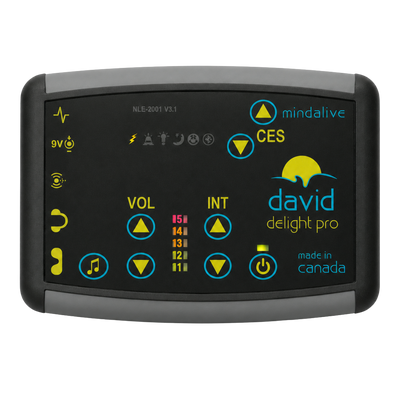
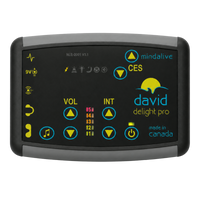
The DAVID Delight Pro provides CES via ear-clip electrodes and allows pairing with AVE (pulsed light and sound). In this system, CES can either follow the selected AVE frequency or operate at a commonly used 100 Hz CES setting. Typical user protocols emphasize comfort and gradual titration.
6.1 Suggested Protocol Considerations
- Electrode placement: ear lobes with conductive clip pads (consistent, low-impedance contact). For auricular vagus targeting, consider clinical literature on tragus/cymba placements (device-specific safety applies).
- Intensity: sub-sensory to light tingling; increase only to a comfortable level. More current is not necessarily better.
- Session duration: 20–30 minutes; frequency: ~3–5 sessions/week for 3–6 weeks, then reassess.
- Pairing with AVE: using calming AVE frequencies (e.g., alpha/theta) may complement CES by concurrently guiding cortical rhythms toward relaxation.
- Outcome tracking: use brief validated scales (e.g., GAD-7 for anxiety, PSQI for sleep quality) and physiological markers (resting HR, HF-HRV if available) pre/post intervention windows.
6.2 Safety and Tolerability
CES is generally well-tolerated. Transient effects may include mild skin irritation under electrodes or transient dizziness/fatigue in sensitive users. Contraindications routinely cited for cranial stimulation—such as implanted electronic devices, active epilepsy without medical supervision, or pregnancy—warrant precaution and medical guidance.
7. Use-Case Domains
- Stress & Anxiety: Autonomic down-regulation and serotonergic modulation align with reported reductions in tension and improved calmness.
- Sleep: Parasympathetic recruitment and decreased cortical hyperarousal may support faster sleep onset and more consolidated sleep.
- Mood & Cognitive State: By stabilizing arousal and influencing monoaminergic systems, users often report clearer focus and improved affect regulation.
These domains map onto long-standing CES program categories on the Delight Pro (e.g., “Sleep,” “Feeling Better,” “Meditate”), enabling structured at-home routines.
8. Integrating CES with Lifestyle and Behavioral Strategies
CES is best viewed as part of a multi-modal plan. Basic sleep hygiene, breathing exercises, graded physical activity, and psychoeducation about stress reactivity can synergize with neuromodulation. When feasible, clinicians may incorporate HRV-biofeedback to reinforce parasympathetic practice.
9. Limitations and Future Directions
Heterogeneity in study designs, stimulation parameters, and endpoints complicates meta-analytic synthesis. Future work should standardize auricular targets, waveform characteristics (frequency, pulse width, duty cycle), and robust autonomic outcomes (e.g., HF-HRV, baroreflex sensitivity). For CES specifically, careful mapping of current density across auricular and cranial tissues—and its relation to ABVN recruitment—will further clarify mechanistic overlap with taVNS. Pragmatic trials in real-world settings (home use, clinician-guided programs) will also refine adherence strategies and effect durability.
Explore CES in Practice
Learn how the DAVID Delight Pro implements comfortable, at-home CES and how AVE pairing may enhance relaxation.
View DAVID Delight Pro10. Practical Quick-Start (Non-Clinical)
- Attach ear-clip electrodes with good contact; sit or lie comfortably.
- Select a calming session (e.g., CES at 100 Hz or CES following an alpha/theta AVE program).
- Begin at low intensity; increase only to comfortable perception.
- Run 20–30 minutes, 3–5×/week for several weeks; track outcomes.
References
Yakovenko, I., et al. (2018). Transcutaneous auricular vagus nerve stimulation: central and autonomic correlates. PubMed. https://pubmed.ncbi.nlm.nih.gov/29361441/
Additional literature on CES, HRV, and autonomic regulation discussed herein reflects peer-reviewed evidence on non-invasive neuromodulation, parasympathetic activation, and stress-sleep-mood pathways.
Disclaimer: This article is for educational purposes only and does not constitute medical advice. Always consult a qualified professional for personalized guidance.