Alpha Waves For Meditation: Explained & Visualized
Mind Alive
Alpha — the 8–12 Hz band your brain produces when calm and internally focused — is the electrical signature of every meaningful meditation state. Here's what it looks like on EEG and how to reliably activate it.
What alpha waves actually are
Alpha waves for meditation have a very specific definition in neuroscience: rhythmic electrical oscillations in the 8–12 Hz range, recorded strongest over the occipital and parietal regions of the cortex when the brain is awake, relaxed and not actively processing visual input. They appear, classically, the moment you close your eyes.
This rhythm was the first brainwave ever documented. In 1924, German psychiatrist Hans Berger recorded it from a patient's scalp and published his findings in 1929 — a paper that effectively created the field of electroencephalography. Almost a century later, alpha remains the most-studied brainwave and the cleanest signature of the relaxed-but-aware state that every serious meditator is pursuing. For a broader look at how sensory stimulation can guide the brain through these bands, see our overview of Audio-Visual Entrainment.
What makes alpha special is not the frequency itself but what happens in the brain when alpha dominates. Visual cortex quiets. Internal attention sharpens. Default-mode-network activity drops. The nervous system shifts toward parasympathetic dominance. In short: the body stops preparing for action, and the mind stops chasing it.
Why alpha is the meditation sweet spot
Every meditation tradition — regardless of lineage — converges on the same experiential target: awake but not alert, focused but not striving, aware but not wandering. On EEG, that description has a clean corollary. It is alpha.
Below alpha, in the theta range (4–7 Hz), the brain slips into dreamlike internal processing — valuable, but difficult to direct. Above alpha, in beta (13–30 Hz), active cognition takes over — the mental state that produces worry, problem-solving and the stress response. Alpha sits in the narrow zone between the two: quiet enough to drop reactivity, aware enough to stay present.
This is why the most measured reductions in anxiety, blood pressure and cortisol occur when subjects enter sustained alpha — not when they attempt to push straight into deep meditative theta. Alpha is the gateway, and for most people, the goal.
Visualizing alpha on EEG
A clinical EEG displays brainwaves as live voltage traces — squiggling lines that reflect synchronized electrical activity across cortical neurons. Different bands have different signatures: fast and jagged (beta), slow and sweeping (delta), smoothly rhythmic (alpha). The visualization below shows the four main bands simplified to the same scale.
Notice the shape difference. Alpha is the smoothest, most regular wave of the four — the brain in rhythm with itself. Beta is jittery and irregular. Theta is slower and dreamier. Delta is glacially slow, only appearing in deep sleep. When you close your eyes and relax, the beta trace visibly quiets and an unmistakable 10 Hz-ish alpha rhythm rises to dominance.

How to activate alpha on demand
If alpha is such a specific state, it helps to have a specific method for reaching it. The list below is ordered roughly by speed and reproducibility — fastest and most measurable first.
1. Audio-Visual Entrainment (AVE)
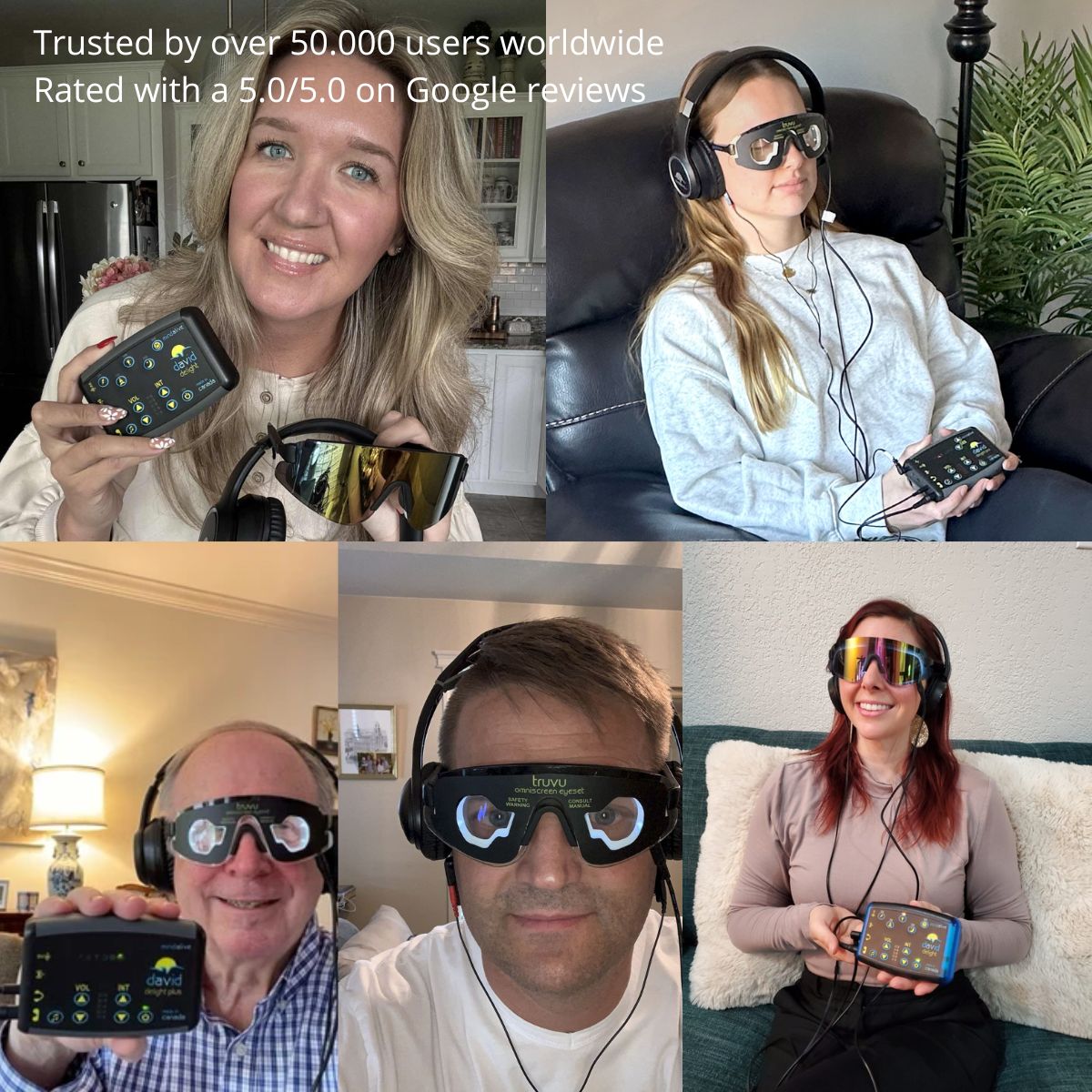
AVE is the most direct path to alpha. A device like the DAVID Premier delivers precisely timed light pulses through a Ganzfeld eyeset and matched isochronic tones through headphones at the target frequency — typically 10 Hz for alpha. Most users enter measurable alpha within 5–10 minutes of a session. No meditation experience required.
2. Eyes-closed relaxation
The simplest alpha trigger. Sit comfortably, close your eyes, let your attention settle on the breath, and stop trying to do anything. Healthy brains produce alpha spontaneously within 30 seconds to a couple of minutes under these conditions — which is exactly how Berger first discovered it.
3. Mindfulness meditation
Open-monitoring mindfulness practices reliably produce alpha increases across practitioners of all experience levels. The effect is real but takes longer to consolidate than AVE, and depends heavily on the individual's ability to stay with the practice.
4. Slow diaphragmatic breathing
Paced breathing at 4–6 breaths per minute increases vagal tone and shifts the nervous system toward parasympathetic dominance — a condition under which alpha emerges much more easily. It won't force alpha, but it removes the beta that usually blocks it.
5. Isochronic tones at 10 Hz
Audio-only entrainment produces smaller but real alpha effects. Isochronic tones generally outperform binaural beats for this purpose — for a full comparison, see our article on related audio protocols.
6. Nature exposure and green spaces
Time in natural environments reliably reduces beta and increases alpha on EEG — a phenomenon documented in numerous "green space" studies over the last two decades. A 30-minute walk in a park is a surprisingly effective alpha protocol.
7. Warm baths and light physical relaxation
A passive warming of the body — hot bath, sauna, relaxed stretching — lowers sympathetic tone and allows alpha to emerge. Not fast, not precise, but reliable.
Building a daily alpha practice
Individual sessions produce state change. Repeated sessions produce trait change — the brain gradually learning to enter alpha on its own, without external stimulation. This is the meaningful neuroplastic shift. Clinical data from the Mind Alive research library suggests the following timeline.
Session 1: Immediate shift
Most people notice a clear quieting within the first 20-minute AVE session at 10 Hz — mental noise softens, the body relaxes, and there is often a mild visual phenomenon as the light pulses work.
Week 1–2: Sleep and anxiety improvement
With daily practice, users report measurable improvements in sleep onset and reduced baseline anxiety within two weeks. The parasympathetic pathways that support alpha are being trained through repetition.
Week 3–4: Sustained cognitive benefits
By the end of the first month, users commonly describe sharper focus under pressure, better emotional regulation, and a recovered ability to "switch off" at the end of the day. These are classic alpha-trait outcomes.
Long-term: Lasting neuroplasticity
After 8–12 weeks of consistent use, many users find they access alpha-like states easily even without the device. Meditation tech is most useful as scaffolding — gradually internalized, not permanently required.
Reduction in anxiety symptoms (STAI scale)
73%Siever, D. (2012). Audio-visual entrainment as a treatment modality. Journal of Neurotherapy.
Improvement in sleep onset and quality (PSQI)
68%Berg, K. & Siever, D. (2009). A controlled comparison of audio-visual entrainment for insomnia.
Enhancement in cognitive performance scores
61%Budzynski, T.H. et al. (2001). Academic performance enhancement with photic stimulation.
Clinicians reporting measurable patient improvement
81%Mind Alive practitioner survey, 2022 (n=1,047 clinicians across 32 countries).
"Alpha is the most accessible and most useful state in practical neuroscience. Every meditation tradition on earth has been chasing it for thousands of years — and with modern AVE, you can reach it on your first session."
— Dave Siever, M.Sc., Founder of Mind Alive Inc.

Is alpha training right for you?
Alpha activation is safe for most healthy adults and is widely used for stress management, sleep support, meditation deepening, ADHD focus training, creative work, and clinician-led therapy. MindAlive's devices are used in over 32 countries — see clinical applications for the specific protocols deployed across different conditions.
There are real contraindications. People with photosensitive epilepsy, active cardiac devices (pacemakers, ICDs), certain neurological conditions, or during pregnancy should consult a healthcare provider before using any photic or electrical stimulation protocol. Stop immediately if you experience headache, dizziness or agitation.
For everyone else: alpha is the most approachable brain state worth training. Beta dominates modern life by default. A short daily alpha practice rebalances the system — and, unlike most interventions that promise this, alpha is cheap to produce, measurable on EEG, and backed by nearly a century of neuroscience.
Frequently Asked Questions
What does it feel like to be in alpha?
Most people describe the alpha state as "calm but awake" — mental noise quiets, the body relaxes, time perception softens, and attention feels easy rather than forced. Eyes are usually closed. Thoughts still arise, but they stop feeling urgent.
How fast can AVE produce alpha?
With a well-designed 10 Hz AVE protocol, most users enter measurable alpha within the first 5–10 minutes of a 20-minute session. The effect is reliable across sessions and typically becomes stronger with repeated use as the brain's alpha pathways strengthen.
Can I get alpha just from a meditation app?
Yes, potentially — open-monitoring and breath-focused apps can produce alpha in healthy users, especially with consistent practice. The effect is smaller and slower to develop than with AVE, but the direction is the same.
Is alpha activation safe?
For healthy adults, yes. 35+ years of AVE research have documented no serious adverse effects from therapeutic use. People with photosensitive epilepsy, active cardiac devices, certain neurological conditions, or during pregnancy should consult a clinician first.
How is alpha different from theta?
Alpha (8–12 Hz) is calm alertness with eyes closed; theta (4–7 Hz) is deeper and more dreamlike, appearing during deep meditation, memory consolidation and the moments before sleep. Alpha is the gateway; theta is what lies beyond it.
Does simply closing my eyes produce alpha?
Often, yes — eye closure reliably increases alpha in healthy brains within seconds (this is how Berger discovered the rhythm in the first place). Sustained, strong alpha under real-world stress, however, requires training or external entrainment.
References
- Berger, H. (1929). Über das Elektrenkephalogramm des Menschen. Archiv für Psychiatrie und Nervenkrankheiten, 87, 527–570.
- Adrian, E.D. & Matthews, B.H.C. (1934). The Berger rhythm: Potential changes from the occipital lobes in man. Brain, 57(4), 355–385.
- Klimesch, W. (1999). EEG alpha and theta oscillations reflect cognitive and memory performance: a review and analysis. Brain Research Reviews, 29(2–3), 169–195.
- Siever, D. (2012). Audio-visual entrainment as a treatment for stress, anxiety and sleep disorders. Journal of Neurotherapy, 14(3), 1–28.
- Berg, K. & Siever, D. (2009). A controlled comparison of audio-visual entrainment for treating seasonal affective disorder and insomnia. Journal of Neurotherapy, 13(3).
- Budzynski, T.H., Jordy, J., Budzynski, H.K., Tang, H., & Claypoole, K. (2001). Academic performance enhancement with photic stimulation. Journal of Neurotherapy, 4(2).
- Cahn, B.R. & Polich, J. (2006). Meditation states and traits: EEG, ERP, and neuroimaging studies. Psychological Bulletin, 132(2), 180–211.