How Does Hemi Sync in Binaural Beats Work? Explained
Mind Alive
Hemi-Sync is Robert Monroe's classic hemispheric-synchronization audio technology — the original commercial binaural beats program. Here's what it actually does, where the evidence is, and how it compares to modern Audio-Visual Entrainment.
What Hemi-Sync binaural beats actually are
Binaural beats Hemi-Sync — short for hemispheric synchronization — is the proprietary audio technology developed by engineer and author Robert Monroe in the early 1970s. It is essentially the ancestor of every modern consumer "binaural beats" product: Monroe was the first to commercialise the perceptual effect that Heinrich Dove had described back in 1839 and Gerald Oster had re-popularised in a 1973 Scientific American article.
The technology became the core of The Monroe Institute, founded in 1974 in Faber, Virginia. Over the following decades, Monroe's team developed hundreds of Hemi-Sync audio programs targeting meditation, sleep, focus, creativity and — more controversially — altered states of consciousness, including out-of-body exploration. For the underlying neuroscience that unites all of these approaches, see our overview of Audio-Visual Entrainment.
What matters here is the core mechanism: Hemi-Sync uses binaural beats as its entrainment stimulus, but layers additional audio elements on top — pink noise, verbal guidance, affirmations, and multiple concurrent tone pairs — that distinguish it from plain single-track binaural files.
How Hemi-Sync differs from standard binaural beats
A plain binaural beat track plays two simple tones — say 200 Hz in the left ear and 210 Hz in the right. The brain perceives a 10 Hz "beat" (the difference), which is thought to encourage alpha-band entrainment via the Frequency Following Response.
Hemi-Sync does considerably more than this. A typical Hemi-Sync track includes:
- Multiple layered binaural tone pairs producing several beat frequencies simultaneously (for example, pairs targeting both alpha and theta).
- Pink or ocean-noise backgrounds that mask external distractions and soften the audio experience.
- Verbal guidance and affirmations in many programs, walking the listener through specific mental exercises or "focus levels."
- Carefully sequenced frequency progressions — starting in beta, moving through alpha into theta or delta, and back — rather than a single static frequency.
This layered approach is richer than plain binaural beats, and many users report it feels more immersive. It is still, however, a purely auditory stimulus — which has implications for how strongly it actually drives EEG activity. For a fuller breakdown of binaural beats themselves, see our HFO binaural beats article.
The hemispheric synchronization concept
The name "Hemi-Sync" refers to the central claim of the technology: that playing appropriately paired binaural tones encourages the two cortical hemispheres to enter a state of increased coherence — producing similar electrical activity, in phase with each other, more reliably than they otherwise would.
The reasoning is intuitive. Binaural beats originate in the brainstem's olivary nuclei, which receive inputs from both ears; from there, coherent activity propagates upward through the thalamus to both hemispheres. A carefully constructed binaural stimulus could, in principle, encourage more synchronised electrical behaviour across the corpus callosum.
In practice, this is harder to measure than it sounds. EEG coherence studies on Hemi-Sync exist but produce mixed results, and the cleanest demonstrations come from Monroe Institute-associated researchers. Independent, large-sample replication — the gold standard in any modern clinical domain — remains limited.

What the research shows (and doesn't)
Research on Hemi-Sync falls into three rough categories. First, there is a substantial body of anecdotal and experiential reports going back to Monroe's own work — interesting, but not the same as controlled evidence. Second, there are peer-reviewed studies, many of them conducted at or in collaboration with The Monroe Institute, reporting effects on anxiety, pre-surgical stress, sleep, and various cognitive tasks. Third, there are independent studies — fewer in number — with generally smaller effect sizes.
The most honest summary: Hemi-Sync probably works for some users in the directions Monroe described — relaxation, sleep onset, meditative absorption — but the evidence base is thinner and less independently replicated than the evidence for AVE, CES or HRV biofeedback. A 2008 meta-analysis by Huang and Charyton surveying brainwave entrainment methods across twenty studies found overall positive but inconsistent effects, with the strongest outcomes clustering in audio-visual (not audio-only) protocols.
For the full research library on modern AVE — where effect sizes have been independently replicated across decades — see the MindAlive research catalogue.
Reduction in anxiety symptoms (STAI scale) — AVE
73%Siever, D. (2012). Audio-visual entrainment as a treatment modality. Journal of Neurotherapy.
Improvement in sleep onset and quality (PSQI) — AVE
68%Berg, K. & Siever, D. (2009). A controlled comparison of audio-visual entrainment for insomnia.
Enhancement in cognitive performance scores — AVE
61%Budzynski, T.H. et al. (2001). Academic performance enhancement with photic stimulation.
Clinicians reporting measurable patient improvement — AVE
81%Mind Alive practitioner survey, 2022 (n=1,047 clinicians across 32 countries).
"Robert Monroe deserves credit for bringing binaural beats into the modern world. But the science has moved on. Combining audio with photic stimulation produces measurably stronger effects than any audio-only system — and that is what the last three decades of peer-reviewed research have consistently shown."
— Dave Siever, M.Sc., Founder of Mind Alive Inc.
Hemi-Sync versus modern Audio-Visual Entrainment
The practical question for a reader is not "is Hemi-Sync real?" but "which approach produces the strongest, most reliable effect on my brain?" Three differences stand out.
Single sensory channel vs. two
Hemi-Sync is audio-only. AVE pairs precisely timed isochronic tones with pulsed light through a Ganzfeld eyeset. Every comparative study to date suggests multi-sensory stimulation drives a larger FFR at the target frequency.
Perceived beat vs. direct pulse
Binaural beats — including Hemi-Sync — rely on a beat the brainstem constructs from two tones. Isochronic tones, used in all DAVID devices, deliver the rhythm directly. For a full comparison, see our isochronic vs. binaural breakdown.
Audio library vs. clinical system
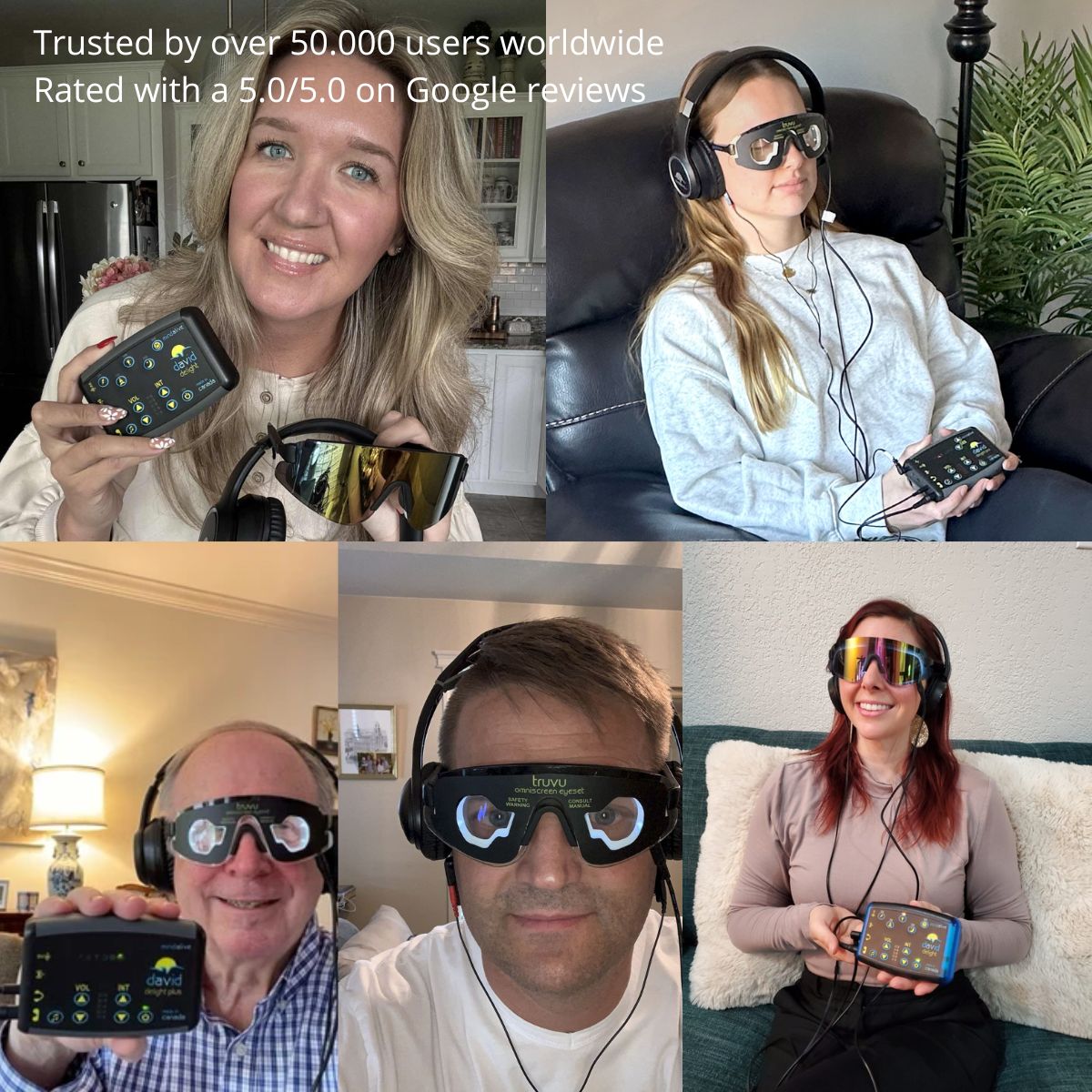
Hemi-Sync is principally a catalogue of audio tracks to play through headphones. The DAVID Premier and Delight range are clinically designed devices with preset programs, photic stimulation, and in some models CES and tDCS stimulation built in.
Is Hemi-Sync right for you?
Hemi-Sync is a legitimate, well-documented audio protocol with decades of user experience behind it. If you enjoy guided audio meditation, are comfortable with headphone-based practice, and respond well to verbal coaching inside a binaural soundscape, it can be an engaging entry point into the world of brainwave entrainment.
What it cannot do is match the measurable EEG effects of combined audio-visual entrainment. If your goal is the strongest possible shift — for sleep difficulties, clinical anxiety, attention challenges, or serious meditation development — the weight of evidence points toward AVE devices like the DAVID Premier or the entry-level DAVID Delight as the more effective choice.
Contraindications apply to both categories. People with photosensitive epilepsy, active cardiac devices (pacemakers, ICDs), certain neurological conditions, or during pregnancy should consult a clinician before using any entrainment technology — especially anything combining light and sound.

Frequently Asked Questions
What exactly is Hemi-Sync?
Hemi-Sync is a proprietary audio technology created by Robert Monroe in the early 1970s that layers binaural beats, pink noise and often verbal guidance to encourage "hemispheric synchronization" — increased EEG coherence between the left and right cortical hemispheres. It is distributed by The Monroe Institute as a catalogue of audio tracks.
Do I need special headphones for Hemi-Sync?
You need stereo headphones — any quality pair that delivers separate audio signals to each ear. Speakers do not work because the two tones need to remain isolated for the binaural effect to emerge. Closed-back or noise-cancelling headphones help by reducing ambient distraction.
Is Hemi-Sync the same as plain binaural beats?
Not exactly. Hemi-Sync uses binaural beats as its core entrainment stimulus but layers multiple concurrent tone pairs, background noise, and often voice guidance. It is richer than a simple two-tone binaural file, though still fundamentally an audio-only protocol.
How does Hemi-Sync compare to AVE (Audio-Visual Entrainment)?
AVE adds synchronised light pulses to audio entrainment, driving the Frequency Following Response across two sensory channels simultaneously. Comparative EEG research consistently finds larger, more reliable effects for combined audio-visual stimulation than for any audio-only system — including Hemi-Sync.
Is Hemi-Sync safe?
For healthy adults, yes — it has decades of safe use behind it. People with seizure disorders, active cardiac devices, or certain neurological conditions should consult a clinician before using any entrainment technology. Stop if you experience headache, dizziness or agitation.
How quickly will I feel effects from Hemi-Sync?
Most users report a clear relaxation response within the first 20-minute listening session. Measurable improvements in sleep or anxiety typically appear with 1–2 weeks of daily use. Deeper trait-level changes usually require months of consistent practice.
References
- Oster, G. (1973). Auditory beats in the brain. Scientific American, 229(4), 94–102.
- Monroe, R.A. (1971). Journeys Out of the Body. Doubleday.
- Atwater, F.H. (1997). Accessing anomalous states of consciousness with a binaural beat technology. Journal of Scientific Exploration, 11(3), 263–274.
- Lane, J.D., Kasian, S.J., Owens, J.E. & Marsh, G.R. (1998). Binaural auditory beats affect vigilance performance and mood. Physiology & Behavior, 63(2), 249–252.
- Huang, T.L. & Charyton, C. (2008). A comprehensive review of the psychological effects of brainwave entrainment. Alternative Therapies in Health and Medicine, 14(5), 38–50.
- Siever, D. (2012). Audio-visual entrainment as a treatment for stress, anxiety and sleep disorders. Journal of Neurotherapy, 14(3), 1–28.
- Adrian, E.D. & Matthews, B.H.C. (1934). The Berger rhythm: Potential changes from the occipital lobes in man. Brain, 57(4), 355–385.