The Science Behind Isochronic Tones vs Binaural Beats
Mind Alive
Both promise to guide your brain toward calm, focus or sleep through sound. But the mechanism — and the strength of the response on EEG — is meaningfully different. Here's what the neuroscience actually shows.
How sound-based brainwave entrainment works
Isochronic tones vs binaural beats is one of the most common questions in audio-based brainwave entrainment — and the honest answer is that the two are not equivalent. Both use rhythmic sound to coax the brain toward a target frequency, but they do it through very different mechanisms, and the EEG evidence behind each is not equally strong.
The underlying principle is the Frequency Following Response (FFR): when the brain is exposed to rhythmic sensory input, cortical activity tends to align with the stimulus frequency. First documented by Adrian and Matthews in 1934 and later expanded by decades of photic and auditory research, the FFR is the neurological basis for every modern form of Audio-Visual Entrainment (AVE).
The practical question is which stimulus produces the strongest, most reliable FFR in the brain regions you care about. That's where isochronic tones and binaural beats diverge.
Binaural beats: the perceptual illusion
Binaural beats were first described in 1839 by Heinrich Dove and rediscovered by Gerald Oster in a landmark 1973 Scientific American article. The mechanism is elegant: play one tone at (for example) 200 Hz into the left ear and a second tone at 210 Hz into the right ear. The brainstem integrates the two inputs and the listener perceives a third, rhythmic "beat" at the difference frequency — in this case, 10 Hz, an alpha-band rate associated with calm focus.
Two features matter here. First, the beat is not a real external sound. It's a construction inside the auditory pathway. Second, the effect requires stereo headphones — if the tones mix acoustically in the room, the illusion collapses.
The binaural approach works best at lower frequencies (roughly below 1,000 Hz) and is commonly marketed for meditation, sleep, and relaxation. For a deeper look at one popular subcategory, see our article on HFO binaural beats.
Isochronic tones: the direct pulse
An isochronic tone is mechanically simpler. A single fixed tone — for example, 200 Hz — is switched on and off at the target rate. If the goal is a 10 Hz alpha state, the tone pulses 10 times per second with equal on/off intervals. The brain is presented with a hard-edged, unambiguous rhythm. No illusion is required, no headphone separation needed; a speaker works fine.
This matters because stimulus contrast drives entrainment strength. The sharper the difference between "sound" and "silence," the more clearly the auditory cortex can lock onto the pulse rate. Isochronic tones, by design, produce the maximum contrast a tone-based stimulus can achieve.
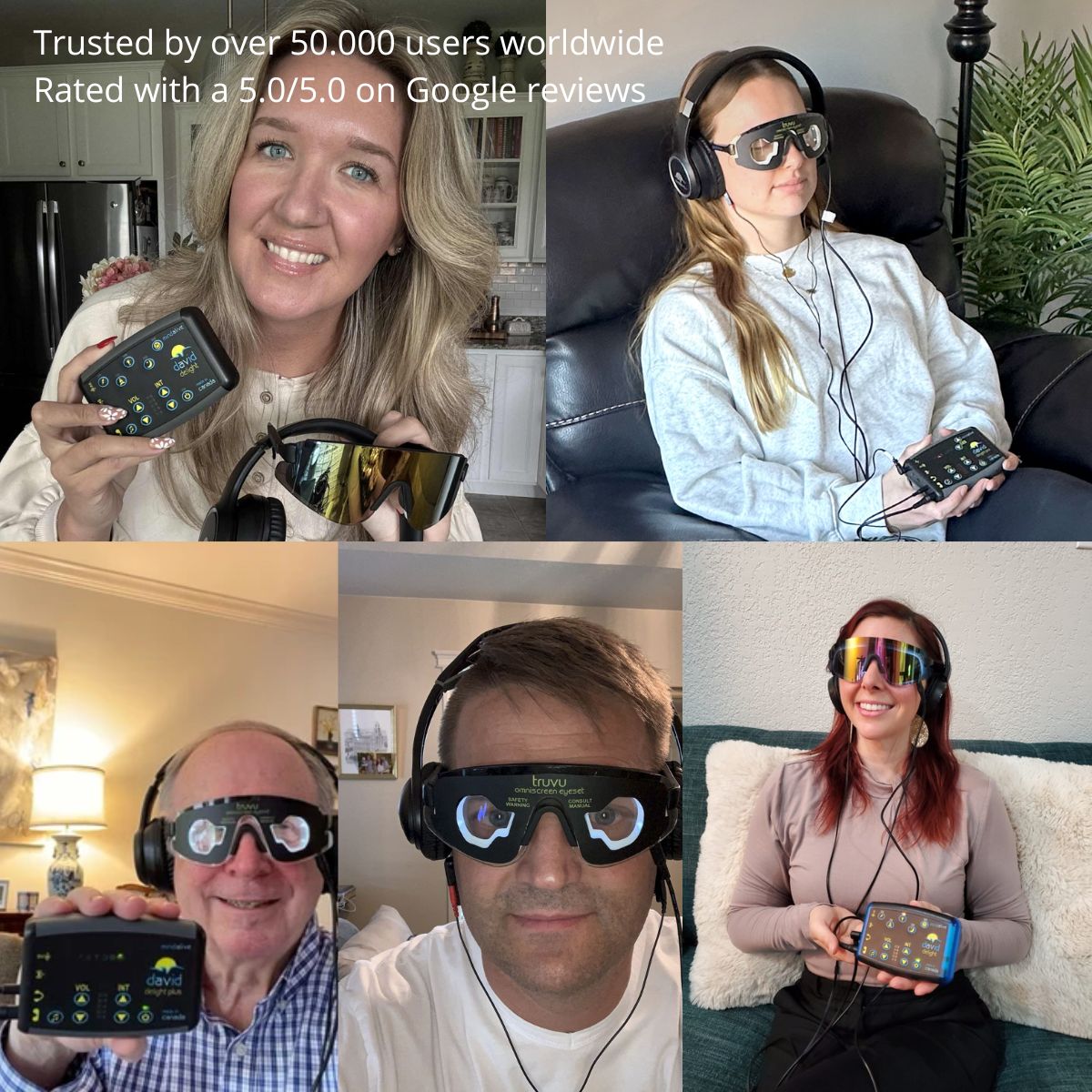
This is also why the DAVID Premier uses isochronic tones — not binaural beats — as its primary audio stimulus, paired with precisely timed light pulses through the Omniscreen Spectrum eyeset.
Stimulus type
Binaural beats = two different tones, one in each ear, where the "beat" is perceived. Isochronic tones = a single tone physically pulsed on and off at the target frequency.
Headphone requirement
Binaural beats require stereo headphones to keep the two tones separated. Isochronic tones work through headphones, speakers, or any audio source — the rhythm is in the signal itself.
EEG response strength
Comparative studies — including work published in the Journal of Neurotherapy — consistently show isochronic tones produce a larger, more reliable Frequency Following Response than binaural beats, particularly above 8 Hz.
What the research actually shows
The evidence picture is mixed for binaural beats and stronger for isochronic tones, particularly when combined with photic stimulation. A 2008 meta-analysis by Huang and Charyton surveyed 20 brainwave entrainment studies across cognition, pain, anxiety and mood and concluded that entrainment produced measurable clinical effects — but noted that studies using isochronic or combined audio-visual protocols generally outperformed pure binaural-beat protocols.
More recent EEG comparisons, including work from David Siever and the Mind Alive research group, have shown that isochronic tones produce a larger amplitude FFR at the target frequency than binaural beats at matched intensity. The full dataset is catalogued in the Mind Alive research library, which now spans four decades of peer-reviewed clinical investigation.
The strongest effects in the literature come from combined audio-visual entrainment (AVE) — isochronic tones paired with light pulses at the same frequency. This is what the DAVID Premier delivers, and it's why the clinical effect sizes cluster well above what any audio-only protocol achieves.
Reduction in anxiety symptoms (STAI scale)
73%Siever, D. (2012). Audio-visual entrainment as a treatment modality. Journal of Neurotherapy.
Improvement in sleep onset and quality (PSQI)
68%Berg, K. & Siever, D. (2009). A controlled comparison of audio-visual entrainment for insomnia.
Enhancement in cognitive performance scores
61%Budzynski, T.H. et al. (2001). Academic performance enhancement with photic stimulation.
Clinicians reporting measurable patient improvement
81%Mind Alive practitioner survey, 2022 (n=1,047 clinicians across 32 countries).
"Isochronic tones are the most effective auditory stimulus for brainwave entrainment we have. They produce a sharper, cleaner frequency-following response than binaural beats — and when combined with photic stimulation, the effect multiplies."
— Dave Siever, M.Sc., Founder of Mind Alive Inc.
How to use each in practice
Both formats are widely available as audio tracks, apps and standalone programs. The practical question is which to use, when — and what realistic results look like over time.
Session 1: Immediate shift
Most users report a noticeable sense of calm within the first session of any well-designed entrainment protocol — isochronic or binaural. Mental chatter quiets, the body relaxes, and some experience mild visual phenomena (if photic stimulation is added). This is the FFR beginning to take hold.
Week 1–2: Sleep and anxiety improvement
With 15–20 minute daily sessions, users typically report easier sleep onset and reduced baseline anxiety by the end of the first two weeks. Parasympathetic activation is being trained through repetition. Isochronic and AVE protocols show these effects more reliably than audio-only binaural tracks.
Week 3–4: Sustained cognitive benefits
By the end of the first month, measurable neuroplastic adaptation begins. The brain becomes more efficient at entering target states on its own. Focus sharpens, emotional regulation improves, and the chronic "switched-on" feeling starts to recede. See our overview of clinical applications for the specific protocols used across anxiety, insomnia and attention.
Long-term: Lasting neuroplasticity
Long-term AVE users report that baseline stress levels remain lower even on days they don't use the device — a signature of genuine neuroplastic change, not just a momentary state shift.

Is auditory entrainment right for you?
Isochronic tones, binaural beats and AVE are safe for most healthy adults. They're used successfully for chronic stress, sleep difficulties, attention challenges, meditation deepening and general cognitive maintenance. Unlike pharmacological options, the side-effect profile across 35 years of research has been negligible.
There are real contraindications: people with photosensitive epilepsy, active cardiac devices (pacemakers, ICDs), certain neurological conditions, or during pregnancy should consult a healthcare provider before starting any entrainment protocol — especially one that includes photic stimulation.
For everyone else: if you want more than a relaxation playlist — if you want a measurable shift in how your brain functions — then the evidence points clearly toward isochronic tones over binaural beats, and toward combined AVE over either alone.
Frequently Asked Questions
Do I need headphones for isochronic tones?
No. Unlike binaural beats, isochronic tones are a single pulsed tone and work through speakers, earbuds or headphones equally well. Headphones can help by reducing ambient distraction, but they are not required for the entrainment effect.
Which is more effective, isochronic tones or binaural beats?
Most comparative EEG research — including work from David Siever and the Mind Alive group — suggests isochronic tones produce a stronger Frequency Following Response than binaural beats at matched intensity. The strongest effects overall come from combining isochronic audio with pulsed photic stimulation (AVE).
How long before I notice effects?
Most users report a noticeable calming shift within the first 15–20 minute session. Measurable changes in sleep onset and baseline anxiety typically emerge within 1–2 weeks of daily use. Neuroplastic adaptation — the brain becoming better at entering target states on its own — generally requires 3–4 weeks of consistent practice.
Are there safety concerns?
Auditory entrainment is well tolerated by healthy adults. People with photosensitive epilepsy, active cardiac devices, or certain neurological conditions should consult a clinician first — particularly before using any protocol that pairs sound with flashing light. Stop immediately if you experience headache, dizziness or agitation.
Why does DAVID Premier combine sound with light?
Because the brain's FFR is strongest when multiple sensory channels deliver the same rhythm simultaneously. Pairing isochronic tones with photic stimulation at the matched frequency produces measurably larger EEG effects than either alone — the scientific rationale behind 35 years of MindAlive's AVE research.
References
- Adrian, E.D. & Matthews, B.H.C. (1934). The Berger rhythm: Potential changes from the occipital lobes in man. Brain, 57(4), 355–385.
- Oster, G. (1973). Auditory beats in the brain. Scientific American, 229(4), 94–102.
- Siever, D. (2012). Audio-visual entrainment as a treatment for stress, anxiety and sleep disorders. Journal of Neurotherapy, 14(3), 1–28.
- Huang, T.L. & Charyton, C. (2008). A comprehensive review of the psychological effects of brainwave entrainment. Alternative Therapies in Health and Medicine, 14(5), 38–50.
- Berg, K. & Siever, D. (2009). A controlled comparison of audio-visual entrainment for treating seasonal affective disorder and insomnia. Journal of Neurotherapy, 13(3).
- Budzynski, T.H., Jordy, J., Budzynski, H.K., Tang, H., & Claypoole, K. (2001). Academic performance enhancement with photic stimulation. Journal of Neurotherapy, 4(2).
- Shealy, C.N., Cady, R.K., Culver-Veehoff, D., Cox, R., & Liss, S. (1998). Cerebrospinal fluid and plasma neurochemicals: Response to cranial electrical stimulation. Journal of Neurological and Orthopaedic Medicine and Surgery, 18(2).