

Meditation for People Who Cannot Meditate
Yrian BrugmanMeditation for people who cannot meditate is not a contradiction. A large share of the people who try sitting meditation give up within weeks, not because they lack discipline, but because an unguided, silent practice asks the mind to do the one thing it resists most: settle on command. This article looks at why that happens and where a guided audio-visual entrainment (AVE) session fits as a more structured, lower-effort way to reach a calmer state.
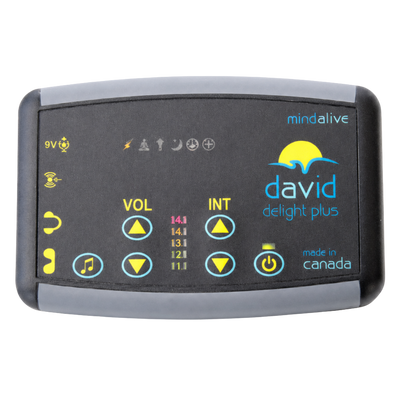
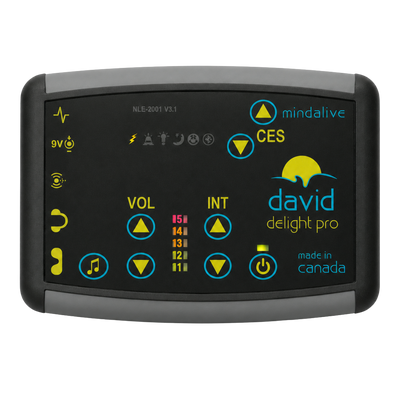
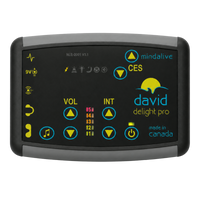
If meditation apps and cushions have not worked for you, a device-led session changes what is being asked of you. Instead of monitoring your own thoughts, you follow pulsing light and sound for a fixed period. The DAVID Delight Pro is the device most people choose for this because it pairs audio-visual entrainment with CES ear-clips in one unit, and it is the most chosen model in the DAVID line.
See the DAVID Delight ProKey Takeaways
- Traditional meditation relies on self-directed attention, which is exactly the skill many beginners and busy adults struggle with most.
- AVE sessions use a fixed light and sound pattern over a set number of minutes, so there is nothing to monitor or "do right."
- Huang and Charyton's 2008 meta-analysis found AVE studied across decades of research for relaxation, anxiety and mood-related outcomes, with session-based use rather than open-ended practice.
- A session is not a replacement for therapy or medical care for anxiety or depression, and it is not a faster route to the same state that experienced meditators reach after years of practice.
- Consistency, not intensity, is what tends to matter: a short daily session is a more realistic habit than an occasional long one.
Why sitting meditation fails for so many people
Most introductions to meditation ask you to sit still, close your eyes, and bring attention back to the breath whenever it wanders. That instruction sounds simple and is genuinely difficult. The wandering mind is not a personal failing. It is the default mode the brain runs in when it is not given a specific external task, and asking it to stop wandering is itself a demanding cognitive task.
For some people this gets easier with practice over months. For others, every session becomes ten minutes of frustration that ends with the thought "I am bad at this," which is usually the point where the habit is dropped altogether. If that has been your experience, the issue is the method, not your capacity to relax.
What changes with a guided, device-led session
An AVE session removes the open-ended part of meditation. Instead of self-monitoring, you are given a structured external stimulus, pulsing light through closed eyelids and matching tones through headphones, at a set pace for a set number of minutes. There is a start and an end. You do not have to decide whether you are "doing it right," because the pattern runs regardless.
This is a different mechanism from classic mindfulness practice, and it is worth being plain about that. DAVID devices are not a form of meditation instruction, and they are not a medical device for treating anxiety or depression. What they offer is a session format, used within protocols, that some people find easier to stay with than unguided stillness.
Research note: Huang and Charyton's 2008 meta-analysis reviewed a broad body of AVE research, including studies on relaxation, mood and anxiety-related outcomes, and found a consistent pattern of positive trends across session-based use, though effect sizes varied by study design.
Where the CES ear-clips come in
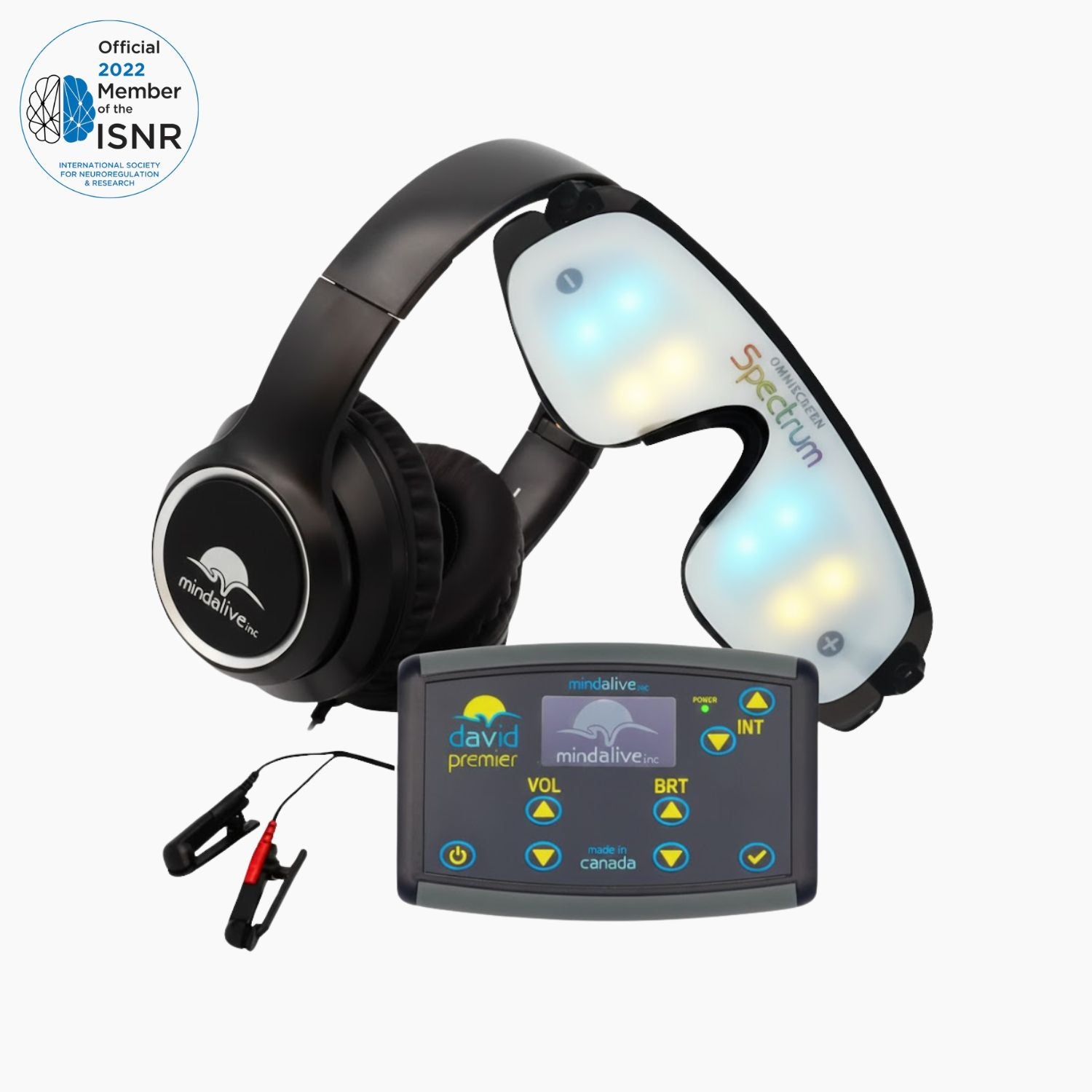
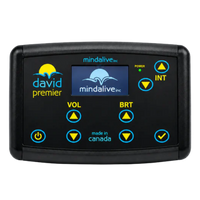
The DAVID Delight Pro and DAVID Premier add cranial electrotherapy stimulation (CES) through small ear-clip electrodes, used in the same session as the light and sound program. CES has been studied separately from AVE, and some protocols combine the two in a single sitting. If this is new to you, read the device manual and start with the shortest suggested session length.
Building a routine you will actually keep
The appeal of a fixed-length session is that it removes decision fatigue. You are not deciding how long to meditate or whether you are deep enough into the practice. You press start, and the device runs its program.
- Pick one time of day, ideally the same time each day, so the session becomes a cue rather than a decision.
- Start with the shortest preset session rather than the longest one.
- Use headphones and a quiet room, with no phone within reach.
- Keep a simple note of how you feel afterward, not during, since you are not meant to be analysing the experience in real time.
- Give it two to three weeks of regular use before judging whether it suits you.
How this compares with other low-effort approaches
If silent meditation has not worked, AVE sessions are one option among several guided approaches. The table below is a plain comparison of what each actually asks of you.
| Approach | What it asks of you | Typical session length | Learning curve |
|---|---|---|---|
| Silent meditation | Self-directed attention, returning focus to breath | 10 to 30 minutes | High, improves slowly over months |
| Guided audio meditation app | Following a spoken voice track | 5 to 20 minutes | Low to moderate |
| AVE session (DAVID Delight Pro) | Wearing eyeset and headphones, no active technique | Set by preset, often 15 to 30 minutes | Low, mostly about consistency |
| Binaural beats app alone | Listening to audio tones, usually without light or CES | Variable, user-set | Low |
For a side-by-side of the DAVID range itself, the devices comparison page breaks down sessions, price and CES by model.
Who this is not a fit for
A session-based approach does not suit everyone. If your main goal is to build long-term attentional skill, such as for a formal mindfulness practice tied to a broader mental training goal, unguided meditation still has something a fixed session cannot replace. And if low mood or anxiety is persistent or affecting daily function, a device is not the place to start. Speak to a doctor or therapist first.
Safety and who should check with a clinician first
DAVID devices are not a medical device for treating disease, and AVE and CES sessions are not suitable for everyone. Do not use these devices if you have a history of photosensitive epilepsy or seizures, or if you have an implanted electronic device such as a pacemaker. If you are pregnant, have a diagnosed mental health condition, or are unsure whether a session is appropriate for you, consult a clinician before starting.
FAQ: Meditation for People Who Cannot Meditate
Is an AVE session the same thing as meditation?
No. Meditation is a self-directed mental practice. An AVE session is a structured external stimulus you follow passively. Some people use both, but they are not interchangeable, and a DAVID device is not sold or positioned as a meditation technique.
Will this fix my anxiety or help me sleep better?
DAVID devices are not a treatment for anxiety, depression or insomnia. AVE has been studied for relaxation and mood-related outcomes, and separately for insomnia in older adults by Tang, Riegel, McCurry and Vitiello (2015), but research findings do not translate into a guarantee for any individual. If you have a diagnosed condition, talk to your doctor first.
How long before a session starts to feel easier?
There is no fixed timeline, and no invented statistic can tell you yours. Most people judge fit after two to three weeks of regular, short sessions rather than after a single try.
Do I need the DAVID Premier or is the Delight Pro enough?
For personal daily use, the DAVID Delight Pro covers 25 sessions plus 3 gamma sessions and CES in one device, and it is the model most people choose. The DAVID Premier adds 50-plus programmable sessions and optional tDCS, and is generally chosen by practitioners running varied protocols for different clients.
What if I fall asleep during a session instead of relaxing calmly?
This is common and not a problem in itself, though it means you are not experiencing the full session as designed. If it happens consistently, try an earlier time of day or a shorter preset.
Can I do this instead of therapy?
No. A session-based device is not a substitute for therapy, counselling or medical treatment. It is a self-care tool some people use alongside, not instead of, professional care.
What does the device actually come with?
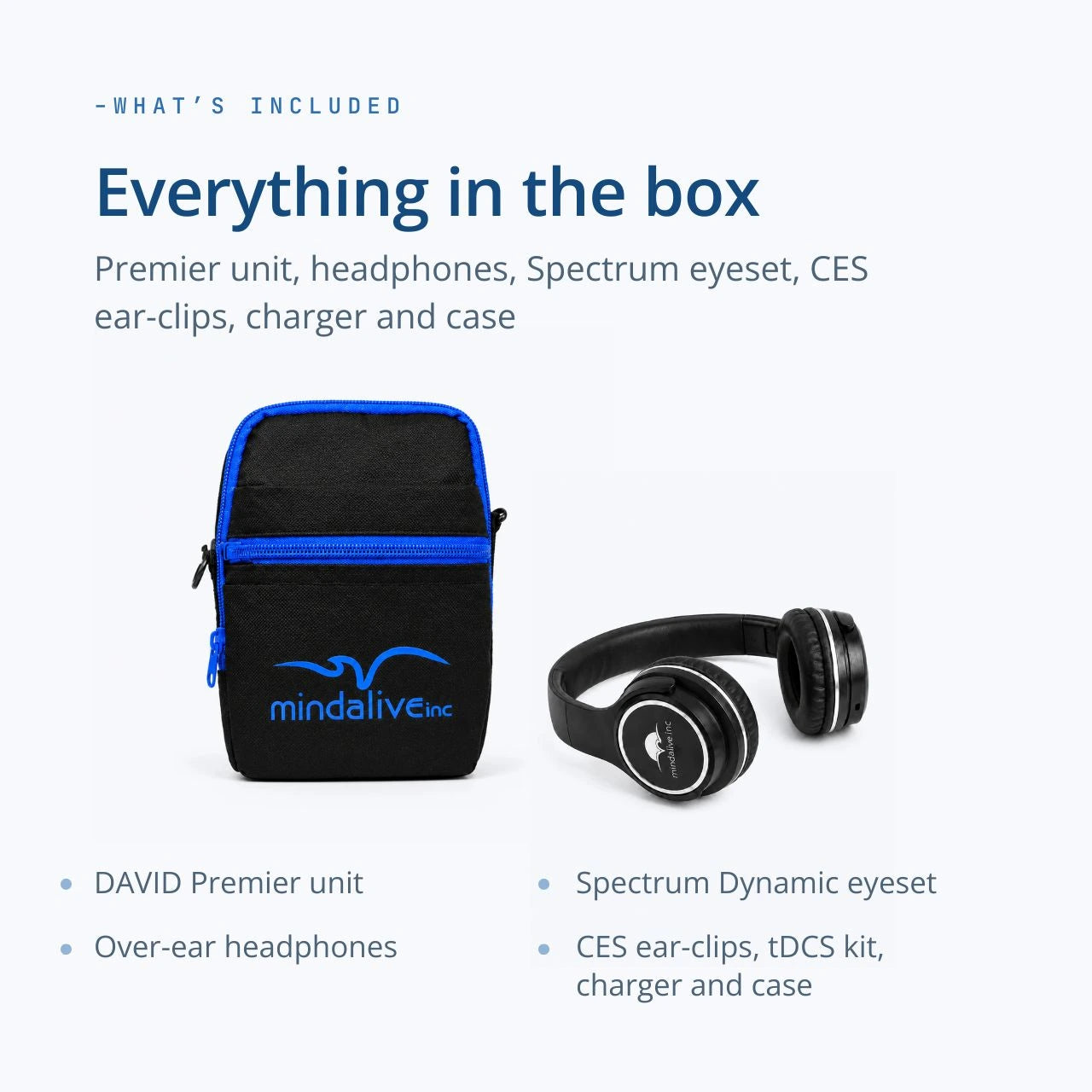
The DAVID Delight Pro ships with the control unit, an eyeset, headphones and CES ear-clips. Every order ships from Mind Alive in Canada by FedEx Express, with delivery in 2 business days within the United States and 3 to 5 business days elsewhere. Orders over $500 ship free to the US and over $800 free worldwide; below that, shipping is $49.95 in the US, $74.95 in Europe and $99.95 elsewhere. Every purchase carries a 30-day money-back guarantee and a 1-year warranty.