

Home Practice Between Neurofeedback Appointments
Yrian BrugmanHome practice between neurofeedback appointments is one of the most overlooked levers a practitioner has. A client who sits for a qEEG-guided session every one or two weeks spends the rest of their time in the same environment, under the same stressors, that shaped their brainwave patterns in the first place. A structured home routine with an AVE or CES device gives the nervous system more frequent, shorter exposures to the states you are training toward, without adding clinic hours to your week.
This guide covers deciding which clients are good candidates, setting a protocol that complements rather than competes with your in-office work, and which DAVID device fits a home-use recommendation. For the full specification comparison, see the devices comparison page.
See the DAVID Delight ProKey Takeaways
- Home AVE and CES sessions between appointments add frequency without adding clinic time, and may support the carryover of states practiced in-office.
- Not every client is a good candidate for unsupervised home use. Screen for seizure history, implanted electronic devices, and the ability to follow a simple protocol.
- A written home protocol with session count, frequency and a check-in point keeps practice aligned with your clinical plan instead of drifting.
- The DAVID Delight Pro is the device most practitioners hand to clients for home use between appointments, pairing AVE with CES ear-clips.
- Track home-session logs alongside office data so you can see whether home practice is actually changing the trend, not just adding noise.
Why the gap between appointments matters
Neurofeedback reinforces specific EEG patterns during a session, then relies on the brain to generalize that pattern into daily life. Shorter, more frequent exposures tend to consolidate skills better than long sessions spaced far apart. A client seen every two weeks gets roughly 24 to 26 reinforcement sessions a year from office visits alone. Add a daily or near-daily 20 to 30 minute AVE or CES session at home, and the client is getting hundreds of additional exposures to a calmer or more focused state over the same period.
This does not replace the qEEG-guided work you do in the chair. It gives the nervous system more repetitions of the general states, relaxation, settled focus, pre-sleep calm, that your office protocol is built around.
What changes between office neurofeedback and home AVE or CES
Office neurofeedback is closed-loop: the system reads the client's live EEG and rewards the brain for producing more of a target pattern. AVE and CES are open-loop: the device delivers a fixed light, sound or micro-current pattern regardless of what the brain is doing in that moment.
- Neurofeedback trains the brain to find a state on its own, using its own signal as the guide.
- AVE guides the brain toward a frequency range through flickering light and pulsed tones, studied for supporting relaxation, sleep onset and sustained attention.
- CES delivers a low-level current through ear-clip electrodes, used within protocols aimed at general relaxation and stress reduction.
- Neither AVE nor CES is a medical device for treating disease. Both may support a state the client is also working toward in office sessions.
Berg and Siever (2009) reviewed AVE's use in clinical settings and framed it as an adjunct within broader treatment plans rather than a standalone intervention. That is the frame worth giving clients: home sessions support the plan, they do not replace the appointments.
Research practitioners often cite when explaining the adjunct role
Huang and Charyton's 2008 meta-analysis of AVE research found consistent support across a range of outcome measures, with the usual caveat that study quality varied. Joyce and Siever (2000) looked at AVE in children with ADHD and reported changes worth further study. Tang, Riegel, McCurry and Vitiello (2015) studied AVE for insomnia in older adults specifically, relevant if a client's goals touch on sleep. None of this is framed as a cure, only as an area that has been studied and may support outcomes you are already working toward.
Framing for clients: "Your appointments here are where we read your brain and train it directly. The device at home gives your nervous system more practice time with the state we are building toward, like repetitions between sets."
Screening clients for home practice
Not every client should walk out with a device. Use the screening you already run before any AVE or CES recommendation, plus a few checks specific to unsupervised home use.
| Screen for | Why it matters for home use |
|---|---|
| History of photosensitive epilepsy or seizures | AVE's flickering light is contraindicated. A hard stop, not a judgment call. |
| Implanted electronic device (pacemaker, defibrillator, neurostimulator) | CES current is contraindicated. |
| Ability to follow a written protocol unsupervised | No clinician is present to catch a skipped step. |
| Pregnancy or current medication changes | Flag to the client's physician first. |
| Comfort with technology | A client who struggles with the device will not use it consistently. |
Informed consent for home use should cover the same ground as in-office consent, with a note that no one is present to monitor the session. Full consent language and contraindications are in Informed Consent and Contraindications for AVE and CES.
Setting a home protocol that complements your plan
A device handed over without a written protocol tends to get used inconsistently, or not at all after the first week. Build it around the same goal as the office sessions, simple enough that a tired client will still do it on a Tuesday night.
- Pick one primary goal per client: pre-sleep calm, daytime relaxation, or sustained focus. Avoid combining multiple goals into one routine.
- Choose two or three sessions from the device library that match that goal.
- Set a frequency: most practitioners start with five sessions a week, 20 to 30 minutes each, for four weeks.
- Add a simple log: date, session used, and a one-line note on how the client felt.
- Review the log at the next appointment and adjust frequency, session choice, or stop home use if it is not fitting.
| Week | Home focus | Check at next appointment |
|---|---|---|
| 1 to 2 | Establish the habit, shortest comfortable length | Is the client completing sessions, and when |
| 3 to 4 | Settle into a consistent choice and schedule | Self-reported changes versus office trend data |
| 5 and beyond | Maintenance, often 3 to 4 sessions a week | Whether trends moved faster since home practice started |
Which device to recommend
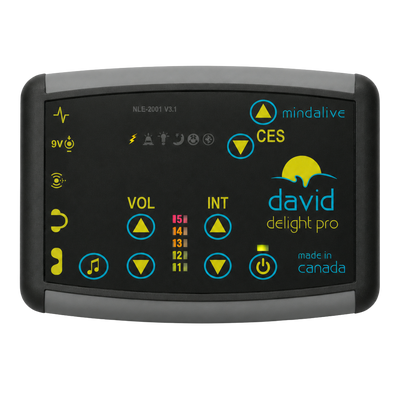
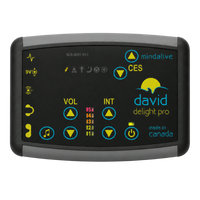
Most practitioners default to the DAVID Delight Pro for home recommendations because it combines AVE and CES in one unit, covering light-and-sound and the ear-clip option without two separate devices.
| Device | What it offers | Typical fit |
|---|---|---|
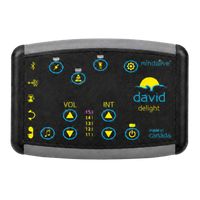
| DAVID Delight | Light and sound, 10 sessions, $349.99 | Budget-conscious clients, basic add-on |
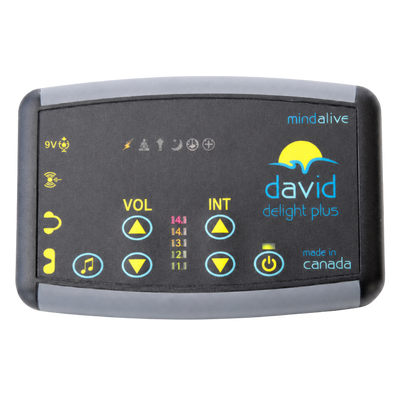
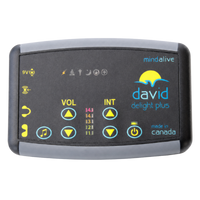
| DAVID Delight Plus | Light and sound, 25 sessions plus 3 gamma, $394.99 | More session variety than the base Delight |
| DAVID Delight Pro | AVE plus CES ear-clips, 25 sessions plus 3 gamma, $559.99 | Most home-use recommendations |
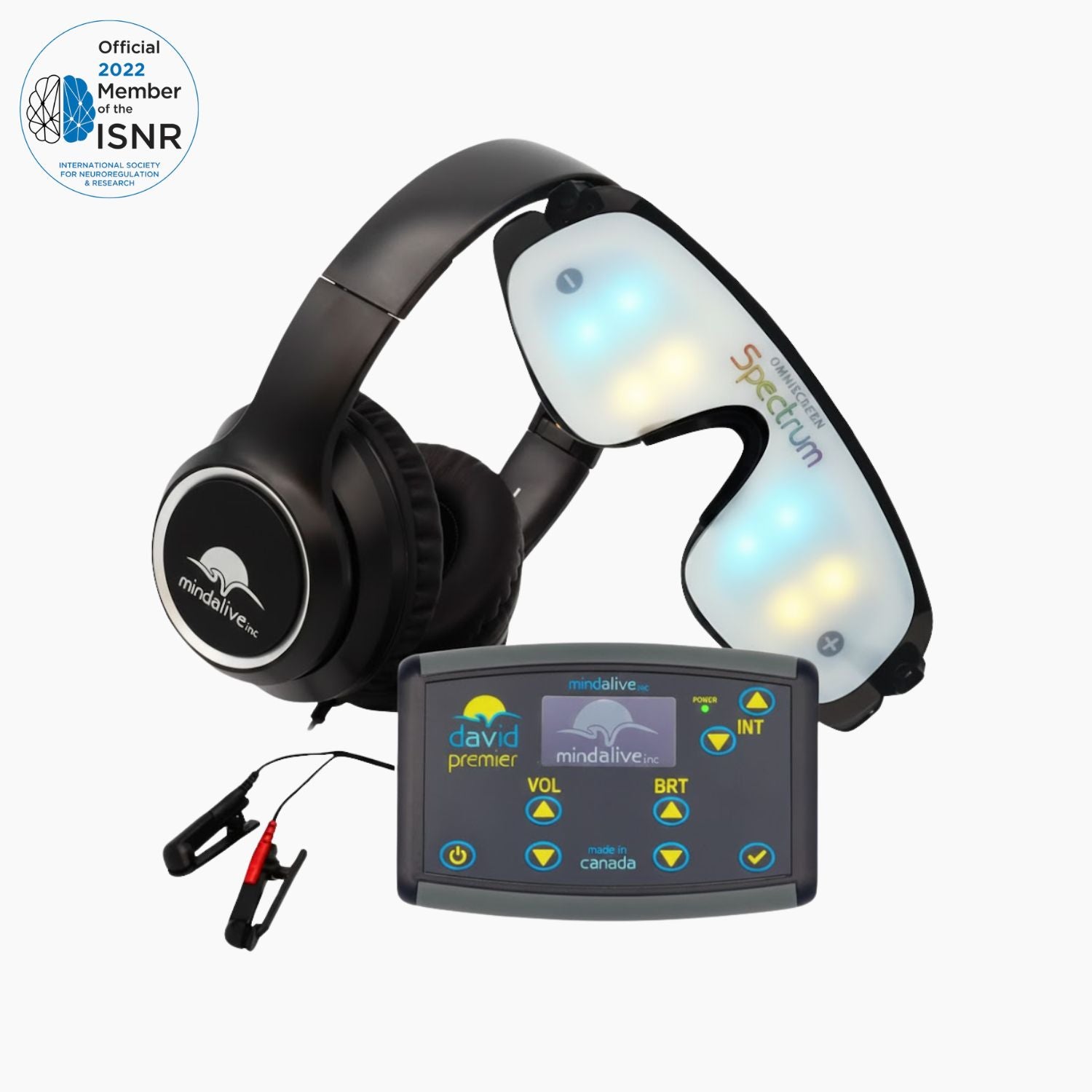
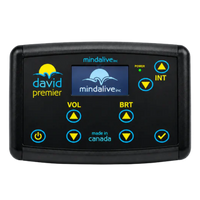
| DAVID Premier | 50+ programmable sessions, CES, optional tDCS, $994.99 | Kept in the clinic rather than sent home |
If a client's goal is narrowly sleep onset or a specific anxiety-adjacent pattern, the smaller session library on the base Delight or Delight Plus is often enough. If you want the option to add CES ear-clip sessions as the protocol evolves, the Delight Pro keeps that door open without a second purchase. See our honest cost-per-session breakdown for what a month of daily use looks like.
Tracking home practice alongside office data
A home log is only useful if you look at it next to your office trend lines. Roberts et al (2018) noted that adjunct interventions are easiest to evaluate when frequency and duration are logged consistently rather than recalled at the next visit. Ask the client to bring their log, paper or phone notes, to every appointment.
- Compare weeks with consistent home practice against weeks without it on the same client's qEEG trend.
- Watch for over-practice, using the device far more than the protocol calls for, which can confound what you see in office sessions.
- Note any client who reports feeling worse after home sessions, and pause use pending a conversation, independent of the office data.
The DAVID companion app can help here. We cover setting it up with clients in How Therapists Add AVE to a Session Plan.
When to escalate back into the office
Home practice should run alongside your plan, not around it. Set a clear rule for when clients should stop home sessions and call you rather than wait for the next scheduled appointment.
- Any new or worsening symptom not present before starting home use.
- A gap of more than two weeks without sessions, which usually means the protocol needs simplifying.
- Any change in medication, pregnancy status, or a new diagnosis involving seizures or an implanted device.
Rule of thumb: if a client would text you before their next visit anyway, that is the signal to pause home sessions until you talk.
FAQ: Home Practice Between Neurofeedback Appointments
Is a home AVE or CES device a replacement for neurofeedback sessions?
No. Home sessions are an adjunct that may support the states trained in the office. They are open-loop and do not read the client's live brain activity the way neurofeedback does.
How many home sessions a week is reasonable to recommend?
Many practitioners start clients at five sessions a week, 20 to 30 minutes each, then move to a maintenance schedule of three to four once the habit and the trend are established.
Which clients should not be given a device for home use?
Anyone with a history of photosensitive epilepsy or seizures, or an implanted electronic device, should not use AVE or CES. Clients who cannot follow a written protocol unsupervised are also poor candidates.
Which DAVID device do practitioners usually send home with clients?
The DAVID Delight Pro is the most common choice, since it covers both AVE and CES ear-clip sessions in one unit at $559.99.
Does Mind Alive ship directly to a practitioner's clinic?
Yes. Every order ships from Canada using FedEx Express, with delivery in 2 business days to the US and 3 to 5 business days elsewhere. Shipping is free in the US over $500 and worldwide over $800; below that it is $49.95 US, $74.95 Europe, and $99.95 rest of world.
What if a client's device needs to be returned?
Mind Alive offers a 30-day money-back return if the device arrives back unused in its original packaging. The customer covers return shipping, and the original shipping fee is not refunded. Contact Mind Alive directly for a return or warranty claim.
Do clients outside Canada and the US pay anything extra at delivery?
Yes, they are responsible for their own import duties, VAT and brokerage fees, collected by FedEx on delivery. Mind Alive charges no VAT at checkout.
AVE and CES devices are not for people with a history of photosensitive epilepsy or seizures, or an implanted electronic device. Have clients consult their physician before starting a home protocol.