Remote Viewing Monroe Institute
Mind Alive
Remote viewing, the Monroe Institute and the CIA Gateway Process — one of the strangest episodes in Cold War research. Here's what actually happened, what the neuroscience supports, and what it meant for modern brainwave technology.
What remote viewing and the Monroe Institute actually are
Remote viewing and the Monroe Institute became linked during one of the strangest chapters of Cold War research — a two-decade effort to find out whether trained individuals could perceive distant, unseen targets through disciplined altered states of consciousness. The research was funded by the CIA, the Defense Intelligence Agency and the US Army, and ran from 1978 until 1995 under codenames including Gondola Wish, Grill Flame, and most famously Project Stargate.
"Remote viewing" itself is a specific protocol: a viewer sits in a quiet room, enters a relaxed meditative state, and attempts to describe a target location, object or event they have no conventional information about. It was developed at the Stanford Research Institute (SRI) by physicists Harold Puthoff and Russell Targ, working with test subjects including artist Ingo Swann and psychic Pat Price.
The Monroe Institute — founded in 1974 in Faber, Virginia by engineer and author Robert Monroe — was not itself a psi research lab, but its Hemi-Sync audio technology became a favourite training tool for intelligence personnel learning to enter the altered states that remote viewing was said to require.

Project Stargate and the CIA's twenty-year experiment
The formal US government remote viewing program was born from reports that the Soviet Union was investing in "psychotronic" research. American intelligence agencies decided that even a small probability of usable effects justified funding parallel work. From 1978 to 1995, an estimated $20 million was spent across a series of programs that SRI, Science Applications International Corporation (SAIC) and the US Army jointly operated.
The units had real offices, real budgets and real test subjects. Some sessions were reported as strikingly accurate; many more produced vague or null results. The program's most famous viewer, Joseph McMoneagle, served in the Army's in-house unit and contributed to hundreds of operational sessions over more than a decade.
In 1995, after mounting internal doubts, the CIA commissioned an independent evaluation by the American Institutes for Research (AIR). The resulting report — authored by statisticians Jessica Utts and Ray Hyman — reached a split conclusion. Utts argued the statistical signal was real; Hyman argued it was not robust enough to rule out methodological confounds. The program was closed the same year.
The Monroe Institute, Hemi-Sync and the Gateway Process
Monroe's own work began with something more personal. In his 1971 book he described spontaneous experiences of consciousness shifts while wearing certain audio headsets — experiences he eventually traced to the binaural-beat phenomenon first described by Heinrich Dove in 1839. He developed an audio technology he called Hemi-Sync (short for hemispheric synchronization) and built a residential training program called the Gateway Experience around it.
In 1983, the US Army Intelligence and Security Command (INSCOM) sent Lieutenant Colonel Wayne M. McDonnell to the Monroe Institute to evaluate its programs. His resulting document — the Analysis and Assessment of Gateway Process — was marked Confidential and sat in government archives for twenty years before being declassified in 2003. The report blended neuroscience, quantum physics speculation, and a sympathetic analysis of Monroe's hemispheric-synchronization model. It went quietly viral on the internet around 2017 and has since been discussed widely in podcasts and online forums.
Much of the report's content is, by modern standards, speculative physics dressed up as analysis. But its description of what Hemi-Sync actually does to EEG — promote relaxed, deeply internal, theta-dominant states — is neurologically consistent with everything now known about binaural entrainment.
What the neuroscience actually supports
Three distinct claims need to be separated here, because only some of them survive scientific scrutiny.
Claim A: Binaural beats produce altered states on EEG
Well supported. Binaural beats and related auditory entrainment methods produce measurable shifts in EEG activity and subjective experience — the Frequency Following Response is a real, replicable phenomenon. See our breakdown of HFO binaural beats for the mechanism.
Claim B: Hemi-Sync helps induce deep meditative states
Supported. The relaxation and introspection Monroe's tracks produce are neurologically plausible and align with decades of meditation EEG research (e.g. Cahn & Polich, 2006). Strong clinical evidence, however, favours combined audio-visual methods over audio-only.
Claim C: Altered states enable remote viewing of distant targets
Not supported. The Stargate program's own independent review concluded the effect, if it existed at all, was too small and inconsistent to be operationally useful. Subsequent meta-analyses remain contested; no mainstream neuroscience framework predicts or explains remote perception.
Keeping these claims separate is essential. Monroe's audio technology is real, his training produces genuine altered states, and his contribution to popular understanding of brainwave entrainment is significant. Whether those altered states confer psi abilities is a completely different question — and the government that funded twenty years of work to answer it, closed the program.

The legitimate legacy: altered-state research
Strip away the metaphysics and there is a genuine scientific contribution at the core of this story. Monroe and his colleagues helped push altered states of consciousness — meditation, hypnagogia, hypnosis, deep relaxation — into a territory where they could be studied with EEG instead of only described in subjective language. That has informed decades of subsequent work on:
- Meditation EEG and the theta/alpha signatures of experienced practitioners
- Hypnagogic and pre-sleep brain states and their creative/integrative functions
- The default mode network and how internal attention is organised
- Clinical applications of theta and alpha training for anxiety, insomnia and attention disorders
Peer-reviewed research collected in the MindAlive research library reflects this lineage without the speculative claims. The question shifted from "can we remotely perceive distant targets?" to "can we reliably produce the brain states that clinically help people?" — and the second question has yielded far more useful answers.
"The most durable legacy of the Monroe era isn't remote viewing — it's the simple observation that consciousness states have measurable electrical signatures, and that the right stimulus can guide the brain to them. Everything we do at Mind Alive rests on that foundation."
— Dave Siever, M.Sc., Founder of Mind Alive Inc.
Reduction in anxiety symptoms (STAI scale)
73%Siever, D. (2012). Audio-visual entrainment as a treatment modality. Journal of Neurotherapy.
Improvement in sleep onset and quality (PSQI)
68%Berg, K. & Siever, D. (2009). A controlled comparison of audio-visual entrainment for insomnia.
Enhancement in cognitive performance scores
61%Budzynski, T.H. et al. (2001). Academic performance enhancement with photic stimulation.
Clinicians reporting measurable patient improvement
81%Mind Alive practitioner survey, 2022 (n=1,047 clinicians across 32 countries).
From Gateway Process to evidence-based entrainment
The practical question today is what to actually do with this lineage. Modern Audio-Visual Entrainment takes the neuroscience at the core of Monroe's work — the observation that rhythmic sensory input entrains brain rhythms — and couples it with peer-reviewed evidence, FDA-cleared elements (for CES), and devices designed for clinical use rather than metaphysical exploration.
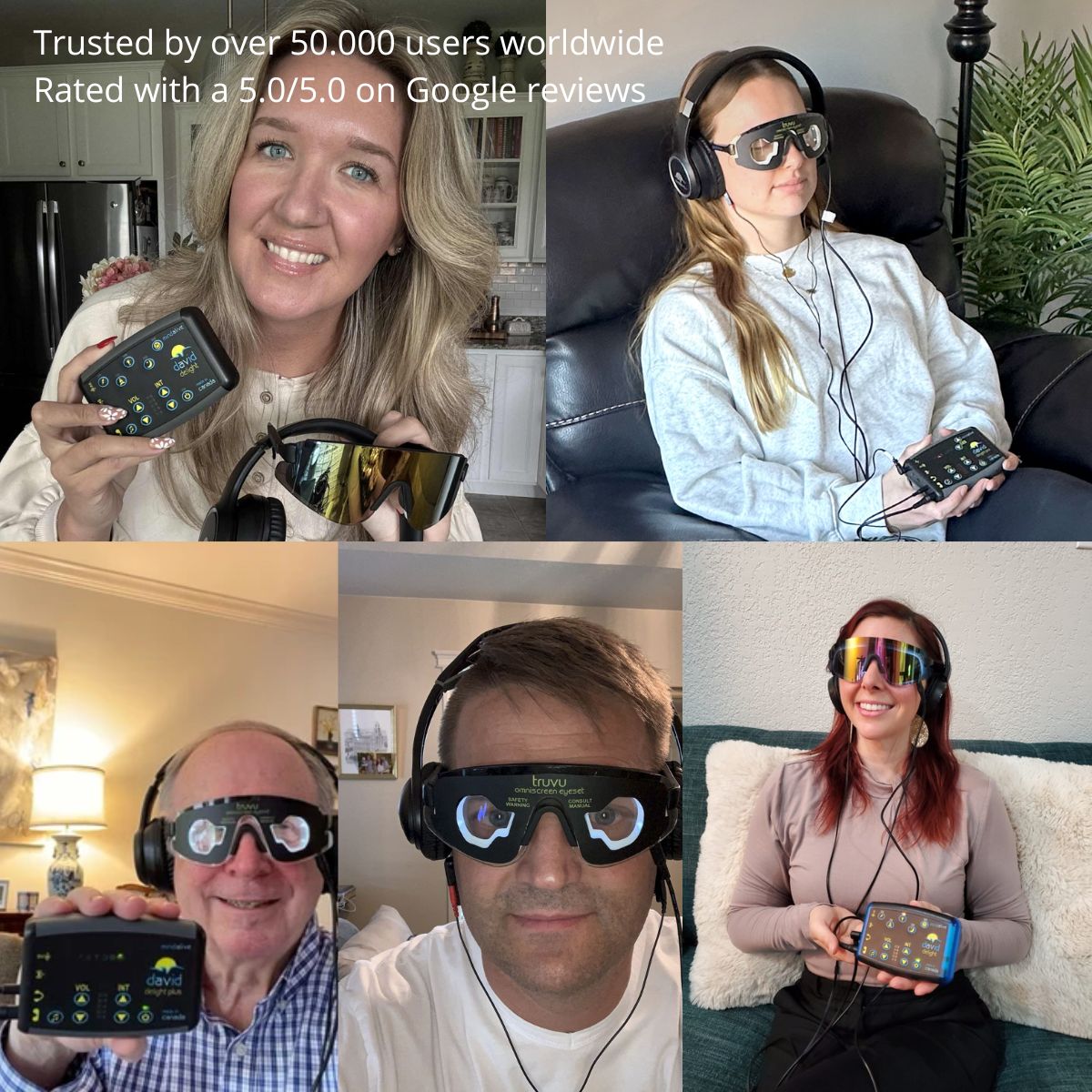
DAVID systems — the DAVID Delight, DAVID Delight Plus, DAVID Delight Pro and DAVID Premier — all pair isochronic tones with pulsed light through a Ganzfeld eyeset, driving the same alpha and theta states the Gateway program chased, but with measurable EEG responses and a rigorous evidence base. People with photosensitive epilepsy, active cardiac devices (pacemakers, ICDs), certain neurological conditions, or during pregnancy should consult a clinician before any entrainment protocol.
Whether or not the human mind can perceive distant targets remains an open question that academia has largely set aside. What is not in doubt is that you can enter the same deep, internally attentive, theta-dominant states the Gateway program chased — and that doing so, regularly, measurably improves sleep, anxiety, focus and creative insight.

Frequently Asked Questions
Did the CIA actually use the Monroe Institute?
Yes. Monroe Institute programs — particularly the Gateway Experience — were used informally and formally by military and intelligence personnel throughout the 1980s. The 1983 US Army Analysis and Assessment of Gateway Process report, declassified in 2003, documents this history explicitly.
Is remote viewing real?
The CIA's own independent review in 1995 concluded that any effect was too inconsistent to be operationally useful, and the Stargate program was terminated that year. Individual researchers continue to dispute the evidence, but mainstream neuroscience does not consider remote viewing scientifically established.
What actually was the Gateway Process?
A six-tape residential training program developed by the Monroe Institute in the late 1970s, using Hemi-Sync binaural audio to walk participants through progressively deeper altered states labelled "Focus 10," "Focus 12," "Focus 15" and beyond. The stated goal was hemispheric synchronization and expanded consciousness; the measurable effect is strong relaxation and theta-dominant EEG.
Is Hemi-Sync the same as what MindAlive does?
They share the same underlying principle — using sensory stimulation to guide brainwave states — but differ significantly in method. Hemi-Sync is audio-only and relies on binaural beats. MindAlive's DAVID devices combine isochronic tones with pulsed light (Audio-Visual Entrainment), producing measurably stronger EEG effects per the peer-reviewed literature.
Can I experience deep meditative states without any psi claims attached?
Yes — and that's exactly what modern AVE is designed to do. Devices like the DAVID Premier reliably produce alpha and theta states for relaxation, sleep support, meditation and creativity, all backed by published clinical data. No metaphysics required.
Is using this kind of technology safe?
For healthy adults, yes. Safety profile across 35+ years of AVE research is excellent. People with photosensitive epilepsy, active cardiac devices (pacemakers, ICDs), certain neurological conditions, or during pregnancy should consult a clinician before use.
References
- McDonnell, W.M. (1983). Analysis and Assessment of Gateway Process. US Army Operational Group (declassified 2003).
- Monroe, R.A. (1971). Journeys Out of the Body. Doubleday.
- Puthoff, H.E. & Targ, R. (1976). A perceptual channel for information transfer over kilometer distances: Historical perspective and recent research. Proceedings of the IEEE, 64(3), 329–354.
- Mumford, M.D., Rose, A.M. & Goslin, D.A. (1995). An Evaluation of Remote Viewing: Research and Applications. American Institutes for Research.
- Cahn, B.R. & Polich, J. (2006). Meditation states and traits: EEG, ERP, and neuroimaging studies. Psychological Bulletin, 132(2), 180–211.
- Huang, T.L. & Charyton, C. (2008). A comprehensive review of the psychological effects of brainwave entrainment. Alternative Therapies in Health and Medicine, 14(5), 38–50.
- Siever, D. (2012). Audio-visual entrainment as a treatment for stress, anxiety and sleep disorders. Journal of Neurotherapy, 14(3), 1–28.