

Apollo Neuro vs DAVID Delight Pro: Which One Fits You?
Yrian BrugmanApollo Neuro and the DAVID Delight Pro both get filed under "wearable wellness tech" in a quick search, but they work in almost opposite ways. One is a passive wearable you keep on under a sleeve all day. The other is a dedicated device you sit down with for a focused session. This guide lays out what each one actually does, where the two genuinely overlap, and which is the better fit depending on how you want a daily practice to feel.
If you already know you want a device built specifically for audio-visual brainwave entrainment, with the option to add cranial electrotherapy stimulation (CES) in the same unit, you can go straight to the DAVID Delight Pro product page. If you are still working out which category of device suits you, keep reading.
See the DAVID Delight ProKey Takeaways
- Apollo Neuro is a wrist or ankle wearable that delivers gentle vibration patterns throughout the day. The DAVID Delight Pro is a light, sound, and CES session device used for dedicated sessions of about 20 to 30 minutes.
- Apollo Neuro is built for continuous, low-level background stimulation you can wear during work, exercise, or sleep. The DAVID Delight Pro is built for structured sessions you set time aside for.
- Audio-visual entrainment (AVE) and CES have each been studied for stress, sleep, and attention-related uses; see the research notes below for specifics.
- The DAVID Delight Pro ships from Canada with a 30-day money-back guarantee and a 1-year warranty, and it is the most chosen device in the DAVID line.
- The two devices are not mutually exclusive. Some people use a wearable for all-day background support and a session-based device like the DAVID Delight Pro for a focused daily practice.
What Apollo Neuro Actually Does
Apollo Neuro is a wearable worn on the wrist or ankle. Instead of light or sound, it works through touch: gentle vibration patterns delivered through the skin, tuned to different modes depending on what you are trying to shift toward, such as calm, focus, or sleep. It is designed to be worn passively, through clothing, during the day or overnight, with no need to sit down or set aside dedicated time.
Because it runs in the background, Apollo Neuro fits into a routine the way a fitness tracker does. You put it on in the morning, switch modes through an app as your day changes, and take it off at night, or leave it on through sleep depending on the mode you choose.
- Worn on the body, not placed over the eyes or ears.
- Designed for continuous, low-level stimulation rather than a single focused session.
- Controlled through a companion app with different vibration modes.
- Can be worn during normal daily activity, including work and light exercise.
What the DAVID Delight Pro Actually Does
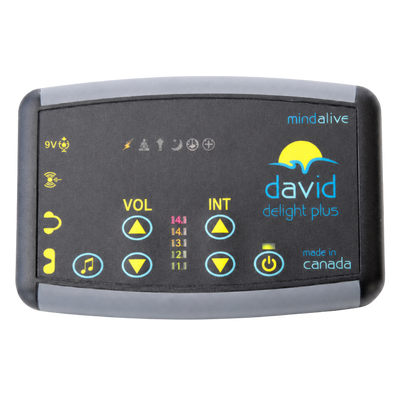
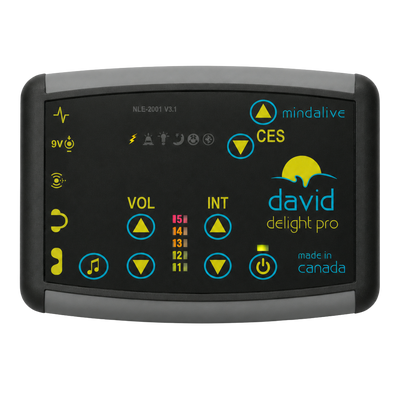
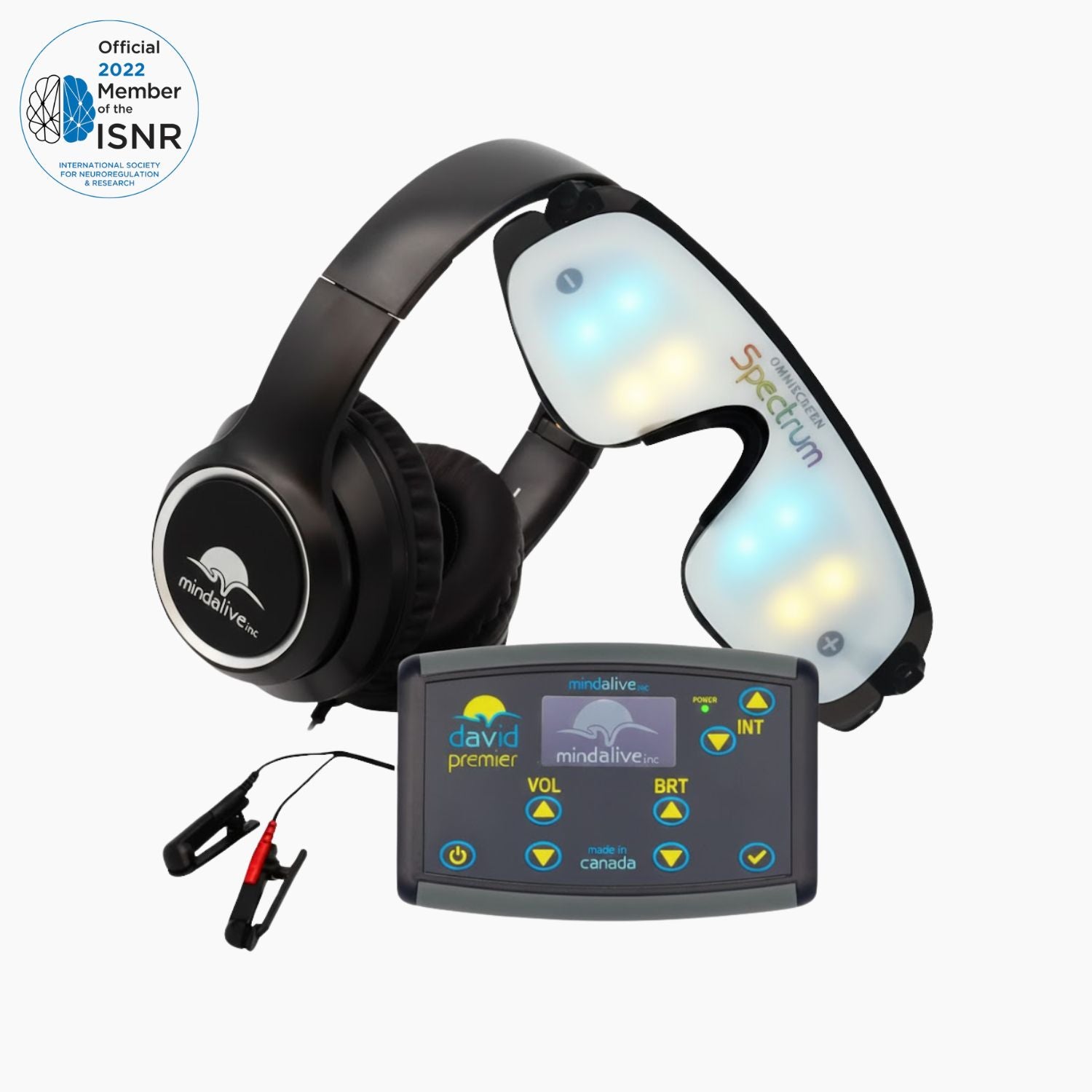
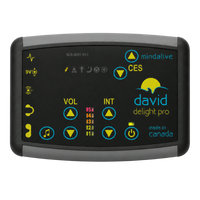
The DAVID Delight Pro works differently. It pairs an eyeset of pulsing light with headphone tones to create audio-visual entrainment (AVE), and it adds CES ear-clips so you can layer in cranial electrotherapy stimulation during the same session. Rather than running in the background, you choose a program, get comfortable in a quiet space, and run a session that typically lasts 20 to 30 minutes.
The device comes with 25 sessions plus 3 gamma sessions built in, covering different states such as relaxation, focus, and sleep preparation. AVE has been studied as a tool that may support relaxation, attention, and sleep quality within structured protocols.
Where the research points: A 2008 meta-analysis by Huang and Charyton reviewed studies on audio-visual and other forms of brainwave entrainment and found associations with improvements across measures including anxiety, behavior, and cognitive performance, while noting that more rigorous controlled trials were still needed.
CES, the electrical component added in the Pro and Premier models, has also been studied separately. Berg and Siever (2009) and Roberts et al. (2018) both looked at CES as a tool that may support a calmer nervous system state, used within a broader wellness or clinical protocol rather than as a standalone cure.
Comparing the Experience
| Dimension | Apollo Neuro | DAVID Delight Pro |
|---|---|---|
| Format | Wrist or ankle wearable | Eyeset, headphones, and CES ear-clips |
| Stimulation type | Touch, through vibration patterns | Light, sound, and optional electrical stimulation (CES) |
| Typical use pattern | Worn continuously through the day or night | Dedicated sessions, roughly 20 to 30 minutes |
| Where you use it | Anywhere, including at your desk or during errands | A quiet seated or reclined space |
| Built-in programs | Modes selected through a companion app | 25 sessions plus 3 gamma sessions |
Who Apollo Neuro Fits Best
Apollo Neuro tends to suit people who want something that works in the background without asking them to carve out dedicated time. If your days are unpredictable, or you want a steady, low-effort layer of support while you work, commute, or sleep, a wearable like this fits that pattern well.
- You want support that does not require sitting still or being in a quiet room.
- You prefer something worn discreetly under a sleeve.
- You are looking for a lighter, more passive addition to an existing routine.
Who the DAVID Delight Pro Fits Best
The DAVID Delight Pro tends to suit people who want a structured practice rather than passive background support, and who are comfortable setting aside 20 to 30 minutes in a quiet space. It also suits people who want the option of combining two studied approaches, AVE and CES, in a single device rather than owning separate tools.
- You want a defined session with a clear start and end, not an all-day background layer.
- You are drawn to light and sound entrainment specifically, not touch-based stimulation.
- You want the flexibility to add CES within the same device rather than buying it separately.
- You want a device studied across more than one use case, including sleep in older adults (Tang, Riegel, McCurry, and Vitiello, 2015).
On sleep specifically: Tang, Riegel, McCurry, and Vitiello (2015) looked at light and sound based approaches to insomnia in older adults and found them worth continued study as a non-drug option used alongside other sleep habits, not as a replacement for medical care.
Can You Use Both?
Yes. Because the two devices work through different mechanisms and different time patterns, there is no inherent conflict in owning both. A common pattern is wearing something like Apollo Neuro through the workday for background regulation, then running a DAVID Delight Pro session in the evening as a dedicated wind-down practice. Neither device is positioned as a medical treatment, so there is no reason one would need to replace the other if your budget and routine support both.
Buying, Shipping, and Returns
If you decide the DAVID Delight Pro is the right category of device, a few logistics are worth knowing before you order. Every order ships from Mind Alive in Canada using FedEx Express only, with delivery in about 2 business days within the United States and 3 to 5 business days to other countries. Shipping is free on orders over $500 to the US and over $800 worldwide; below those thresholds, shipping is $49.95 to the US, $74.95 to Europe, and $99.95 to the rest of the world. Customers outside Canada and the US are responsible for their own import duties, VAT, and brokerage fees, collected by FedEx; Mindalive does not charge VAT at checkout.
Every device comes with a 30-day money-back guarantee and a 1-year warranty. If you want to return a device, contact Mindalive first; it needs to arrive back unused and in its original packaging within 30 days of purchase, and the customer covers return shipping, with the original shipping fee not refunded. Warranty claims go directly through Mindalive.
FAQ: Apollo Neuro vs DAVID Delight Pro
Is Apollo Neuro a light and sound machine like the DAVID Delight Pro?
No. Apollo Neuro works through touch, using vibration patterns delivered through a wearable on the wrist or ankle. The DAVID Delight Pro works through light and sound via an eyeset and headphones, with the option to add CES ear-clips. They are different categories of device, not two versions of the same technology.
Does the DAVID Delight Pro also use touch-based stimulation like Apollo Neuro?
Not in the same way. The DAVID Delight Pro's CES ear-clips use mild electrical stimulation rather than vibration, and they are used during a seated session rather than worn continuously throughout the day.
Which one is better for sleep?
Both have been used within sleep-focused routines, but through different approaches. AVE and light and sound sessions have been studied for insomnia in older adults (Tang, Riegel, McCurry, and Vitiello, 2015). Apollo Neuro's vibration modes are designed to be worn passively overnight. Which one fits your sleep routine better depends on whether you prefer a wind-down session before bed or a wearable you leave on while you sleep.
Can I use Apollo Neuro and the DAVID Delight Pro on the same day?
Yes. There is no known conflict between wearing a vibration-based device during the day and running a light, sound, and CES session in the evening. Many people use one for background support and the other for a dedicated practice.
Is either device a treatment for a medical condition?
No. The DAVID Delight Pro is not a medical device for treating disease. AVE and CES have been studied for and may support relaxation, sleep quality, and attention-related routines when used within a sensible protocol, but neither device cures, treats, or heals any condition. The DAVID Delight Pro is not recommended for anyone with a history of photosensitive epilepsy or seizures, or with an implanted electronic device. Consult a clinician before starting either device, especially if you have a relevant medical history.
What is included with the DAVID Delight Pro, and what does it cost?
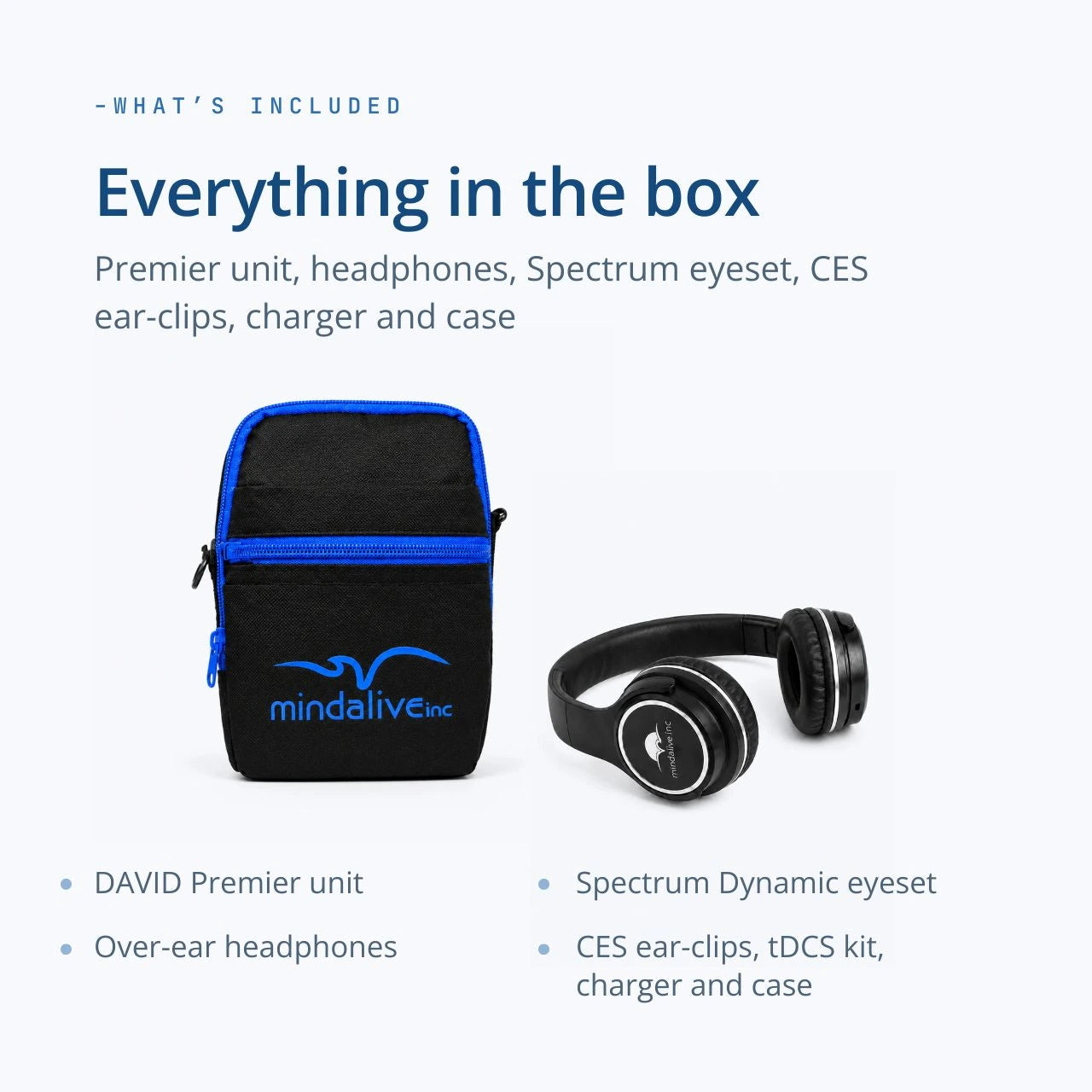
The DAVID Delight Pro is $559.99 and includes the light and sound eyeset, headphones, CES ear-clips, and 25 sessions plus 3 gamma sessions. It ships from Canada with a 30-day money-back guarantee and a 1-year warranty.
What if I am still not sure which category of device is right for me?
Start by asking how you actually want to build the habit: do you want something worn passively through the day, or a session you sit down for with a clear start and end? If it is the latter, the brainwave assessment can help narrow down which DAVID program fits your goals.