

Muse Headband vs DAVID Delight Pro: Which Fits You?
Yrian BrugmanMuse headband vs DAVID Delight Pro is a comparison that confuses a lot of shoppers, because the two devices get grouped together under "brain tech" even though they do almost opposite jobs. Muse watches your brain and reports back. DAVID Delight Pro takes an active role and guides your brainwaves through a session. This guide walks through what each device actually does, where each one earns its price, and which one fits a racing mind at bedtime, a meditation practice that never quite clicks, or a focus routine that apps alone have not solved.
If you already suspect you want a device that leads rather than one that scores, have a look at the DAVID Delight Pro before you decide.
See the DAVID Delight ProKey Takeaways
- Muse is an EEG headband that reads your brain activity and turns it into audio feedback during meditation; it does not deliver light, sound or electrical sessions.
- DAVID Delight Pro is an audio-visual entrainment (AVE) device with CES ear-clips that actively runs a program, so there is far less to interpret or learn.
- Muse suits people who already meditate and want a progress signal; DAVID Delight Pro suits people who want structure because unguided meditation has not worked for them.
- Neither device treats or cures a condition. DAVID is studied for relaxation, focus and sleep support within structured protocols, and results vary by person.
- DAVID Delight Pro ships from Canada with a 30-day money-back guarantee, a 1-year warranty, and free US shipping over $500.
What the Muse Headband Actually Does
Muse is a lightweight headband with dry EEG sensors across the forehead and behind the ears. It pairs with a smartphone app and turns your brain's electrical activity into audio feedback during a seated meditation session, usually the sound of wind, rain or birdsong that calms as your mind settles and grows more turbulent as your attention wanders. The idea is straightforward: you sit, you breathe, you listen, and over repeated sessions you learn, by trial and error, what internal state produces the calmer sound.
What Muse does not do is deliver anything to your brain. There is no light sequence, no paced tone, no electrical stimulation. It is purely a sensing and feedback tool. The work of changing your state is left entirely to you, guided only by the sound cues the app produces.
What the DAVID Delight Pro Actually Does
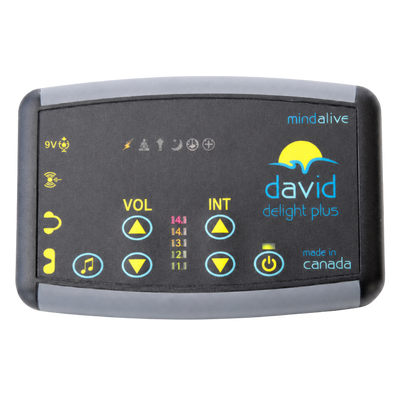
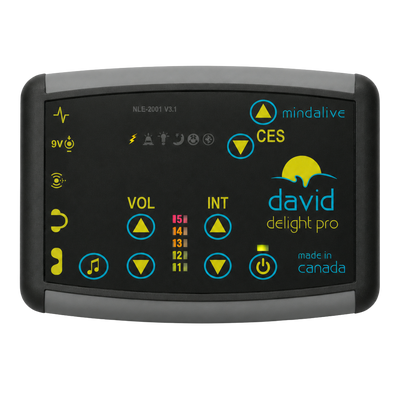
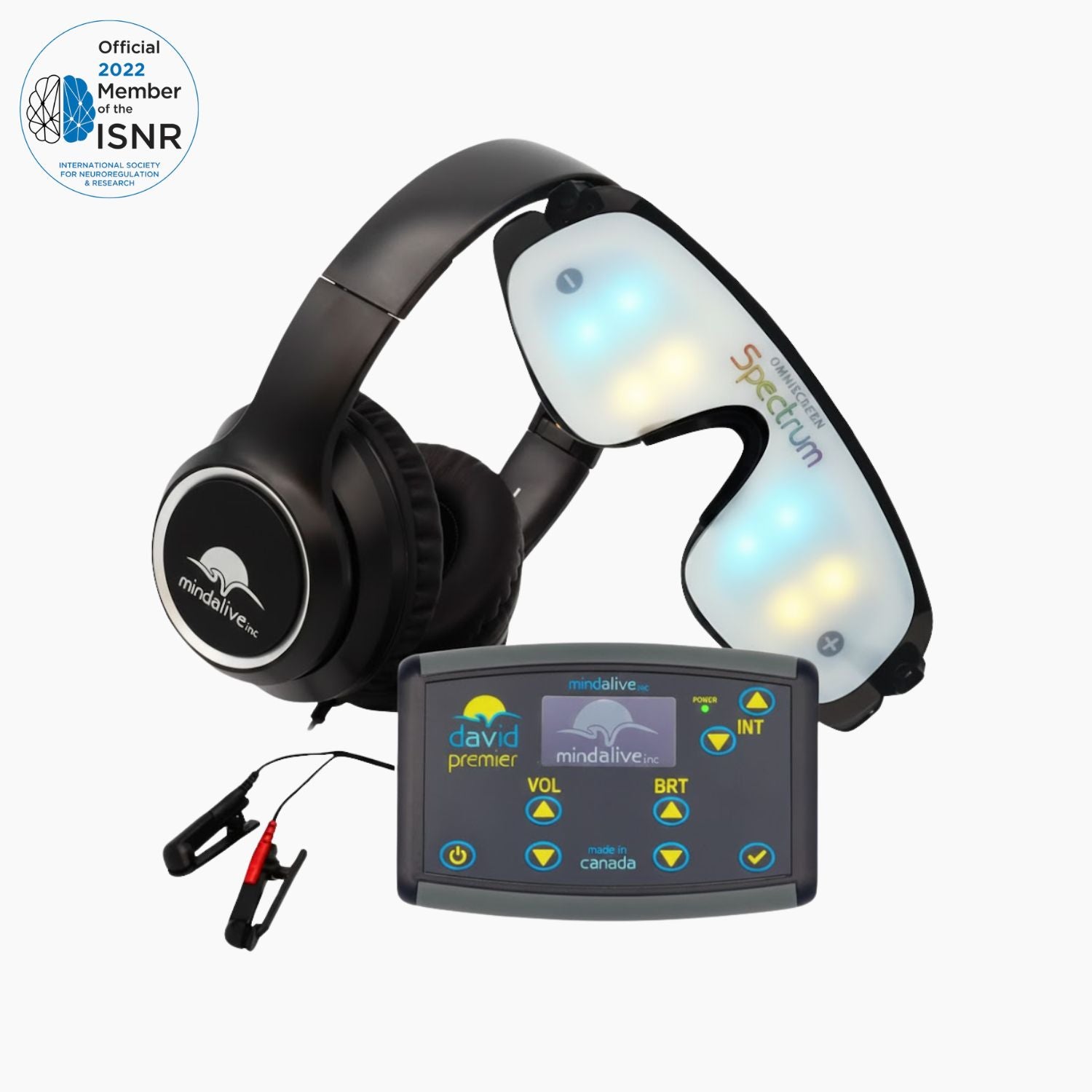
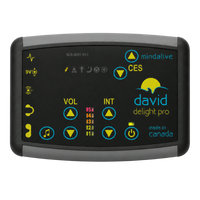
DAVID Delight Pro is an audio-visual entrainment (AVE) device paired with CES ear-clips. Instead of reading your brain and reporting back, it runs a chosen session through an eyeset and headphones: light pulses and matched tones at frequencies designed to gently guide brainwave activity toward a target state, such as alpha for calm, SMR or beta for focus, or theta for deep relaxation, plus a handful of gamma sessions. The CES ear-clips add a low, gentle current used within protocols studied for relaxation and stress. You choose a session, put on the eyeset, and the device paces the experience for you.
In plain terms: Muse tells you how still your mind is right now. DAVID Delight Pro gives your mind something structured to follow toward stillness, so there is less guessing about whether you are "doing it right."
DAVID is not a medical device for treating disease. Audio-visual entrainment has been studied for a range of outcomes, and a 2008 meta-analysis by Huang and Charyton found it associated with improvements across several measures including anxiety and cognitive performance. CES has been studied by Berg and Siever (2009) within protocols aimed at relaxation and stress. These are associations seen in research, not guarantees, and the device should be used within the frame of "may support," not "will fix."
Side by Side: Muse vs DAVID Delight Pro
| Feature | Muse Headband | DAVID Delight Pro |
|---|---|---|
| What it does | Reads brain activity, converts it to audio feedback | Actively runs light, sound and CES sessions |
| Who does the work | You interpret feedback and adjust yourself | The device paces a pre-set session for you |
| Modality | EEG sensors, audio only | Light eyeset, paced tones, CES ear-clips |
| Sessions included | App-based, open-ended | 25 sessions plus 3 gamma sessions |
| Best suited for | Building or tracking a meditation practice | Relaxation, focus and sleep routines, especially without a meditation background |
| Price | Set by the manufacturer; check current listing | $559.99 |
| Returns and warranty | Varies by manufacturer | 30-day money-back, 1-year warranty |
Who the Muse Headband Suits Best
Muse works best for people who already have some comfort with seated meditation and want a way to measure their own consistency over weeks or months. If you enjoy data, like seeing a session score, and are motivated by small improvements in a graph, the feedback loop can be genuinely useful. It assumes you already know roughly how to settle your attention; the headband's job is only to tell you how well you are doing it.
- You already meditate and want a progress signal, not a new technique.
- You are comfortable interpreting feedback and adjusting your own breathing or focus.
- You want a lightweight, app-based tool rather than an eyeset and headphones.
Who the DAVID Delight Pro Suits Best
DAVID Delight Pro suits people for whom unguided meditation has not worked, or who want a structured alternative to sitting in silence and hoping their mind cooperates. If you have tried meditation apps and found yourself more frustrated than calm, a session that paces the experience with light and sound removes the open-ended part of the practice. See our guide on meditation for people who cannot meditate for more on this specific problem.
- You want a device to lead the session rather than one that scores your own effort.
- You are looking for help with sleep, stress or focus and prefer a fixed program over trial and error.
- You want CES included for relaxation protocols, not just light and sound alone.
- You want 30 days to try it at home and send it back if it is not a fit.
Can You Use Both Devices?
Yes, and some people do, because the two tools solve different problems. A person might use Muse during an unguided sitting practice earlier in the day and reach for DAVID Delight Pro in the evening when they want a structured session to wind down before sleep. That said, most people are better served by starting with the one that matches the problem they actually have: a tracking problem points to Muse, a guidance problem points to DAVID Delight Pro. Buying both on day one rarely makes sense unless you already know you will use each for its own purpose.
What the Research Says, and What It Does Not Say
Audio-visual entrainment and CES have a research history that predates most consumer wellness wearables. Huang and Charyton's 2008 meta-analysis reviewed AVE studies and found associations with improvements in outcomes including anxiety, behavioral issues and cognitive performance. Berg and Siever (2009) studied CES and AVE combined within protocols for anxiety and depression symptoms. None of this research supports claims that any device cures or treats a diagnosed condition, and none of it applies to EEG feedback headbands like Muse, which are measurement tools rather than entrainment devices and sit in a separate research category of their own.
Safety note: DAVID Delight Pro is not recommended for anyone with a history of photosensitive epilepsy or seizures, or with an implanted electronic device. If either applies to you, consult a clinician before use.
FAQ: Muse vs DAVID Delight Pro
Which is better for falling asleep faster?
DAVID Delight Pro is built for this use case directly, with sessions designed to guide brainwave activity toward calmer states before bed. Muse can support a wind-down meditation, but it only measures your effort rather than actively guiding it.
Do I need meditation experience to use DAVID Delight Pro?
No. The sessions are pre-set and paced by the device, which is part of why people who struggle with unguided meditation often prefer it over a feedback-only tool.
Does Muse use light or electrical stimulation?
No. Muse is an EEG sensor and feedback device only. It does not deliver light pulses, paced tones designed for entrainment, or any electrical stimulation.
Is the CES in DAVID Delight Pro safe to use daily?
CES ear-clips are used within structured protocols studied for relaxation and stress, and the device includes session presets rather than open-ended use. Check the included guidance for your specific session plan, and consult a clinician if you have any underlying health concerns.
Which device is easier for a complete beginner?
DAVID Delight Pro, because there is nothing to interpret. You select a session and the device runs it. Muse requires you to already have some sense of how to settle your attention, since its feedback only tells you how close you are getting.
Can I return either device if it does not work for me?
DAVID Delight Pro comes with a 30-day money-back guarantee; contact Mindalive first, and the device must arrive back unused in its original packaging within 30 days, with the customer covering return shipping. Return policies for Muse are set by its own manufacturer.
Do I need an app to use DAVID Delight Pro?
The device runs its built-in sessions on its own. The DAVID companion app is optional and mainly used by practitioners and people who want to track session history.